
(Article Updated Jan. 6 and 8, 2026)
This article lists federal and state consumer law changes scheduled to go into effect or expire during the period from December 1, 2025, through January 1, 2027. Other consumer law changes will be enacted in 2026 and will go into effect in 2026; this article lists changes whose effective dates have already been scheduled as of December 31, 2025.
Of special importance are extensive changes to student loan rights, important bankruptcy amendments affecting mortgages, a new regulation change affecting PACE, sunset of exemption from taxability for forgiven mortgage and student loan debt, the California Combating Auto Retail Scams (CARS) Act, and two new state coerced debt laws.
NCLC encourages readers to submit (to [email protected]) additional consumer law changes effective in 2026, especially changes in state consumer legislation. NCLC will add appropriate submissions to this article.
December 1, 2025: Bankruptcy Rules and Forms
Bankruptcy Rules and Forms: Important amendments to Bankruptcy Rule 3002.1 and six related new bankruptcy forms went into effect on December 1, 2025. The changes protect homeowners who use chapter 13 bankruptcies to stave off foreclosures and keep themselves current on their mortgages, giving them information needed to successfully complete a cure plan and emerge from chapter 13 without surprise, undisclosed fees, or payment amounts due. See NCLC, Guide to Major Changes to Mortgage Servicing Bankruptcy Rule. New Rule 8006(g) will clarify that any party to an appeal may file a request that a court of appeals authorize a direct appeal.
January 1, 2026: QPRI; Student Loans, TILA; FCRA; CLA; HMDA; FHA, HECM, VA, and GSE Mortgages; CRA; Arizona; California; Colorado; Connecticut; Georgia; Illinois; Indiana; Kentucky; Louisiana; Maryland; Michigan; Ohio; Oregon; Rhode Island; Minimum Wage in 19 States (Affecting Wage Garnishment)
Qualified Principal Residence Indebtedness Exclusion from Income: 26 U.S.C. § 108(a) provides that certain forgiveness on a mortgage loan is not considered income for income tax purposes, but the Qualified Principal Residence Indebtedness Exclusion from Income expired at the end of 2025. It has been extended (often at the last minute) for many years, but as of now, there is no further extension, and thus has expired January 1, 2026. Although other exclusions from taxability of forgiven debt may apply, this exclusion no longer applies.
Taxability of Federal Student Loan Discharges and Cancellations: The American Rescue Plan Act temporarily removed federal income tax consequences for all federal student loan discharges and cancellations that occurred between January 1, 2021, and December 31, 2025. See 26 U.S.C. § 108(f)(5). This exclusion has not been extended, and the amounts discharged or cancelled from federal student loans starting on January 1, 2026, may count toward taxable income unless another exclusion applies.
Truth in Lending Act Exemption: On January 1, 2026, the TILA threshold exempting certain credit with an amount financed over a specific dollar amount increases from $71,900 to $73,400. See 90 Fed. Reg. 57,882 (Dec. 15, 2025). This exemption does not apply to home-secured credit or student loans. See NCLC’s Truth in Lending § 2.7.4.
Truth in Lending Act HOEPA Loans: On January 1, the adjusted total loan amount threshold for high-cost mortgages increases from $26,968 to $27,592, and the adjusted points and fees dollar trigger for high-cost mortgages increases from $1,348 to $1,380. See 90 Fed. Reg. 57,890 (Dec. 15, 2025). See also NCLC’s Truth in Lending § 9.6.4.
Truth in Lending Act Ability-to-Repay and QM Adjustments: To determine whether a covered transaction is a qualified mortgage (QM), the total points and fees charged may not exceed the threshold set for the size of the loan. Effective January 1, 2026, these thresholds increase. For QMs under the general QM loan definition in 12 C.F.R. § 1026.43(e)(2), the thresholds for the spread between the annual percentage rate (APR) and the average prime offer rate (APOR) in 2026 will be: 2.25 or more percentage points for a first-lien covered transaction with a loan amount greater than or equal to $137,958; 3.5 or more percentage points for a first-lien covered transaction with a loan amount greater than or equal to $82,775 but less than $137,958; 6.5 or more percentage points for a first-lien covered transaction with a loan amount less than $82,775; 6.5 or more percentage points for a first-lien covered transaction secured by a manufactured home with a loan amount less than $137,958; 3.5 or more percentage points for a subordinate-lien covered transaction with a loan amount greater than or equal to $82,775; or 6.5 or more percentage points for a subordinate-lien covered transaction with a loan amount less than $82,775. For all categories of QMs, the thresholds for total points and fees in 2026 will be 3% of the total loan amount for a loan greater than or equal to $137,958; $4,139 for a loan amount greater than or equal to $82,775 but less than $137,958; 5% of the total loan amount for a loan greater than or equal to $27,592 but less than $82,775; $1,380 for a loan amount greater than or equal to $17,245 but less than $27,592; and 8% of the total loan amount for a loan amount less than $17,245. See 90 Fed. Reg. 57,890 (Dec. 15, 2025). See generally NCLC’s Truth in Lending § 9.3.3.
Truth in Lending Act Appraisal Requirements: Effective January 1, the exemption threshold for special appraisal requirements for “higher-risk mortgages” increases from $33,500 to $34,200. See 90 Fed. Reg. 58,141 (Dec. 16, 2025). See also NCLC’s Truth in Lending § 9.3.3.
Truth in Lending Credit Cards: Truth in Lending Reg. Z, 12 C.F.R. §§ 1026.6(b)(2)(iii) and 1026.60(b)(3) require creditors to disclose any minimum interest charge exceeding $1.00 that could be imposed during a billing cycle. For 2026, this amount remains unchanged at $1.00. See 90 Fed. Reg. 57,890 (Dec. 15, 2025). See also NCLC’s Truth in Lending § 6.7.8.3.1.
Truth in Lending Exemption for Mortgage Loans: Effective January 1, 2026, creditors with assets under $2.785 billion (formerly $2.717 billion) do not have to establish escrow accounts and do not have to comply with the prohibition on balloon payments for certain higher-priced mortgage loans. For certain insured depository institutions and insured credit unions meeting certain conditions, the exemption threshold is increased to $12.485 billion from $12.179 billion. 91 Fed. Reg. 447 (Jan. 7, 2026).
HMDA Exemption: Effective January 1, 2026, banks, savings associations, and credit unions with assets of $59 million or less as of Dec. 31, 2025, are exempt from collecting data in 2025 (the old threshold was $58 million). 91 Fed. Reg. 445 (Jan. 7, 2026).
Community Reinvestment Act (CRA): The CRA asset thresholds for certain exemptions are increased as of January 1, 2026, so that ‘‘small bank’’ means a bank that, as of December 31 of either of the prior two calendar years, had assets of less than $1.649 billion. “Intermediate small bank’’ will mean a small bank with assets of at least $412 million as of December 31 of both of the prior two calendar years and less than $1.649 billion as of December 31 of either of the prior two calendar years. See 91 Fed. Reg. 509 (Jan. 7, 2026).
Fair Credit Reporting Act (FCRA) File Disclosure: Effective January 1, 2026, the maximum charge to a consumer under the FCRA for file disclosure is $16.00, up from $15.50. 90 Fed. Reg. 57,888 (Dec. 15, 2025). Consumers are also entitled to certain free disclosures, including free weekly file disclosures from Equifax, Experian, and TransUnion. See NCLC’s Fair Credit Reporting Act § 3.3.
Consumer Leasing Act Exemption: On January 1, 2026, the Consumer Leasing Act exemption for consumer leases exceeding a total contractual obligation amount is increased from $71,900 to $73,400. See 90 Fed. Reg. 57,878 (Dec. 15, 2025). See also NCLC’s Truth in Lending § 13.2.2.
FHA Loan Limits: FHA has announced new loan limits for 2026. The single-family, low-cost-area ceiling increases to $541,287 and the high-cost-area ceiling increases to $1,249,125. See HUD Mortgagee Letter 2025-23 (Dec. 11, 2025).
HECM Loan Limits: For HECM reverse mortgages the maximum claim amount increases on January 1 to $1,249,125. See HUD Mortgagee Letter 2025-22 (Dec. 11, 2025).
VA, Fannie Mae, and Freddie Mac Loan Limits: The FHFA announced conforming loan limits for 2026 for Fannie Mae and Freddie Mac mortgages. VA mortgages follow these numbers as well. In most of the United States, the 2026 value for 1-unit properties will be $832,750. For areas in which 115% of the local median home value exceeds the baseline conforming loan limit value, the applicable loan limit for 1-unit properties will be $1,249,125.
Arizona Litigation Financing: Arizona has a new litigation financing statute, Ariz. Rev. Stat. Ann. §§ 12-3451 to 12-3455, effective January 1 2026.
California Arbitration Requirements: Cal. SB 82, effective January 1, 2026, provides that for consumer agreements an arbitration provision's scope is limited to the goods, services, or credit that is the subject of the agreement, so that the arbitration provision should not apply to other transactions or disputes unrelated to the use, payment, or provision of the subject of the transaction.
California Self-Storage: Cal. SB 709 requires self-storage rental agreements initially entered into on or after January 1, 2026, to disclose, in a prescribed manner, whether the rental fee is discounted or promotional, whether the rental fee is subject to change, and the maximum rental fee that the owner could charge during the first 12 months following the date of the rental agreement.
California Overdraft Fees: Cal. AB 1075, effective January 1, 2026, prohibits a California state credit union from charging an overdraft fee or a nonsufficient funds fee exceeding $14, or the amount set by the federal Consumer Financial Protection Bureau for the fee, whichever is lower.
California Social Media: Cal. AB 656, effective January 1, 2026, requires a social media platform to provide a clear and conspicuous button that enables the user to delete their account and provide the user with the necessary steps to delete the user’s account and personal information. The bill prohibits a social media platform from obstructing or interfering with a user’s ability to delete their account.
California Car Rentals: Cal. AB 1374 strengthens consumer price transparency in car rentals by ensuring that, after selecting the location, dates, and vehicle type, renters see the complete cost up front, whether booking directly through a rental car company or via third-party platforms such as Priceline or Booking.
California Algorithm Pricing: Cal. AB 325, effective January 1, 2026, loosens proof requirements for a price fixing claim under state law and prohibits use or distribution of a common pricing algorithm as part of a price fixing scheme. Cal. SB 763 also significantly increases civil and criminal penalties for violations of the state anti-trust law.
California Artificial Intelligence: Cal. AB 316, effective January 1, 2026, prohibits a defendant who developed, modified, or used artificial intelligence from asserting a defense that the artificial intelligence autonomously caused the harm to the plaintiff.
California Food Delivery Apps: Cal. AB 578, effective January 1, 2026, requires a food delivery platform to provide a full refund to the customer if an order is not delivered or the wrong order is delivered and to provide a mechanism that allows the customer to adjust a gratuity that was included in the order prior to its delivery. The food delivery platform must also provide a customer service feature that allows a customer to contact a natural person.
Colorado Junk Fees: Colo. HB 25-1090, effective January 1, 2026, prohibits a person from advertising pricing for a good, service, or property unless the person clearly and conspicuously discloses the maximum total of all amounts that a person may pay, although government and shipping charges can be excluded. The bill also prohibits a landlord from requiring a tenant to pay certain fees, charges, or amounts. A violation is a state UDAP violation.
Colorado Right to Repair: On January 1, 2026, Colo. HB 1121 (2024), goes into effect extending Colorado’s right to repair laws to certain electronic equipment, including cell phones, computers, and televisions. A manufacturer of digital electronic equipment must facilitate the repair of its equipment by providing certain other persons with the resources needed to repair the manufacturer's digital electronic equipment.
Connecticut 2022 UCC Amendments: 2022 amendments to the Uniform Commercial Code address emerging technologies, providing updated rules for commercial transactions involving virtual currencies, distributed ledger technologies (including blockchain), artificial intelligence, and other technological developments. The amendments span almost every article of the UCC and add a new Article 12 addressing certain types of digital assets defined as “Controllable Electronic Records.” The amendments also clarify the UCC’s applicability to mixed transactions involving both goods and services. The amendments also contain some miscellaneous revisions unrelated to technological developments that affect consumer transactions. Connecticut has adopted these amendments effective January 1, 2026. See Conn. HB 6970. Thirty-three jurisdictions have now adopted the 2022 amendments.
Georgia Litigation Financing: Georgia has a new litigation financing statute, Ga. Code Ann. §§ 7-10-1 to 7-10-11, regulating foreign third-party litigation funders that goes into effect on January 1, 2026.
Illinois Coerced Debt: Ill. Pub. Act 104-0297, effective January 1, 2026, provides various protections for domestic partners whose partner coerces them to take on debt, whether by force or fraud.
Illinois Property Exemption: Effective January 1, 2026, Ill. SB 1738, prohibits a judgment creditor from levying on any household goods except that a creditor may obtain court permission to levy on any item that has a resale value of more than $5,000 unless that item is exempt under another provision. One piece of jewelry up to $5,000 is exempt. 735 Ill. Comp. Stat. § 5/12-1001(a).
Illinois Bank Account Protections from Seizure: Effective January 1, 2026, Ill. SB 1738 provides that in the case of a consumer debt judgment entered on or after January 1, 2020, $1,000 of the $4,000 wild card is automatically applied to the judgment debtor’s interest in a checking or savings deposit account. This sum is protected until the return date of the garnishment, at which time the judgment debtor must claim the exemption or lose it. 735 Ill. Comp. Stat. § 5/12-1001(b).
Illinois Homestead and Other Exemptions: Ill. SB 1738 increases the state’s homestead exemption from $15,000 to $50,000 ($100,000 if there are two or more owners), for a car from $2,400 to $3,600, for work tools and professional books from $1,500 to $2,250, and for a payment to compensate for personal bodily injury from $15,000 to $22,500.
Illinois Enforcement of Judgments: Ill. SB 1738 provides that a judgment for a consumer debt entered on or after Jan. 1, 2026, is enforceable for fifteen years but may not be revived. 735 Ill. Comp. Stat. § 5/2-1602.
Indiana Data Privacy: effective January 1, 2026, the Indiana data privacy statute goes into effect, establishing comprehensive new data privacy requirements. 2023 Ind. SB 5 (May 1, 2023).
Indiana Earned Wage Payday Loans: Ind. HB 1125, effective January 1, 2026, is a partially industry-sponsored bill that protects earned wage payday loans, but includes some consumer protections, prohibiting making expedite fees the default option, or suggesting a default tip greater than zero, and also requires the provider, if a consumer elects a no-cost option, to initiate the delivery of the proceeds not later than one business day.
Kentucky Data Privacy: effective January 1, 2026, the Kentucky data privacy statute goes into effect, establishing comprehensive new data privacy requirements. Ky. HB 15 (2024).
Louisiana Motor Vehicle Documentary Fees: Beginning January 1, 2026, the base maximum fee is adjusted annually to the lesser of (1) $425, adjusted by inflation or (2) the amount resulting from applying a growth rate of three percent to the adjusted maximum fee for the previous calendar year. The Louisiana Motor Vehicle Commission shall publish the adjusted maximum fee on its official website. La. Stat. Ann. § 6:969.18(A)(7), (B).
Maryland Virtual Currency Kiosks: Md. SB 305 regulating virtual currency kiosks went into effect on July 1, 2025, but the requirement that kiosks register with the state is effective January 1, 2026.
Michigan Installment Loans: On January 1, 2026, the maximum loan processing fee on installment loans will change from the current $400. See In re CPI-Adjusted Regulatory Loan Act Loan Processing Fee, Bulletin 2024-05-CF (Mich. Dep’t of Ins. & Fin. Servs. Jan. 17, 2024), available at www.michigan.gov.
Ohio Motor Vehicle Doc Fees: The motor vehicle maximum document fee in Ohio is updated annually to reflect inflation. According to the Ohio Dealer Licensing website, the fee will increase to $398 on January 1, 2026, effective through December 31, 2026.
Oregon 2022 UCC Amendments: 2022 amendments to the Uniform Commercial Code address emerging technologies, providing updated rules for commercial transactions involving virtual currencies, distributed ledger technologies (including blockchain), artificial intelligence, and other technological developments. The amendments span almost every article of the UCC and add a new Article 12 addressing certain types of digital assets defined as “Controllable Electronic Records.” The amendments also clarify the UCC’s applicability to mixed transactions involving both goods and services. The amendments also contain some miscellaneous revisions unrelated to technological developments that affect consumer transactions. Oregon adopted these amendments effective January 1, 2026. See Or. SB 167. Thirty-three jurisdictions have now adopted the 2022 amendments.
Oregon Medical Debt: Or. SB 605, effective January 1, 2026, prohibits medical service providers from reporting the amount or existence of medical debt to a consumer reporting agency (CRA), and prohibits a CRA from including in a consumer report an item that the CRA knows or should know is medical debt. Punishes a violation of the Act as an unlawful practice under the state UDAP statute.
Rhode Island Data Privacy: R.I. SB 2500 is effective January 1, 2026, establishing a comprehensive new data privacy law.
Minimum Wage and Wage Garnishment in 19 States: In addition to federal wage garnishment protections that use the federal minimum wage in calculating protected earnings, many states set limits on wage garnishment utilizing the state’s own regulation of the minimum wage. Nineteen states are raising the minimum wage on January 1, 2026: Arizona ($15.15), California ($16.90) (29 California localities also increased their minimum wages), Colorado ($15.16), Connecticut ($16.94), Hawaii ($16), Maine ($15.10), Michigan ($13.73), Minnesota ($11.41), Missouri ($15.00), Montana ($10.85), Nebraska ($15.00), New Jersey ($15.92, with certain variations), New York ($17.00/16.00 depending on location), Ohio ($11.00), Rhode Island ($16), South Dakota ($11.85), Vermont ($14.42), Virginia ($12.77), and Washington State ($17.13). See this report from the National Employment Law Project covering state and local changes in the minimum wage. For more on state formulas for protecting wages from garnishment, see NCLC’s No Fresh Start: Will States Protect Families from Wage and Asset Seizures as Debt Levels Soar? (Dec. 2025) See also NCLC’s Collection Actions § 15.2, Appx. H.
January 6, 2026: FCC Rule on TCPA Revocation of Consent
FCC Rule on TCPA Revocation of Consent: The FCC's new rule on revocation of consent, 47 C.F.R. § 64.1200(a)(10), was to be effective on April 11, 2026. On January 6, the FCC delayed implementation of the rule until January 31, 2027 while it conducts additional review. The rule if it becomes effective would state that a called party may revoke prior express consent to receive calls or text messages by using any reasonable method to clearly express a desire not to receive further calls or text messages from the caller or sender. The rule also specifies several methods of revoking consent which are reasonable per se and prohibits callers and texters from designating an exclusive means to request revocation of consent. See Rules and Regulations Implementing the Telephone Consumer Protection Act of 1991, CG Docket No. 02-278, Order, DA 25-312 (Apr. 7, 2025). See also NCLC’s Federal Deception and Abuse Law § 6.4.5.5.1.
January 7, 2026: Federal Student Loan Wage Garnishment
Federal Student Loan Wage Garnishment: The Department of Education has announced that the week of January 7 it will begin rolling out notices to those in default on their federal student loans that the Department will begin garnishing wages. This is administrative wage garnishment not requiring a court judgment. The Department indicates it will soon ramp up the number of notices being sent—there are presently over five million student loan borrowers in default. The Department’s regulations specify that the amount that can be garnished from wages is the lesser of 15% of disposable income or the amount exceeding $217.50 in weekly disposable income. See 34 C.F.R. § 34.19(b). Borrowers have at least 30 days to make arrangements to prevent garnishment. See generally NCLC’s Student Loan Law § 9.4.
January 16, 2026: New Jersey Telemarketing
New Jersey Telemarketing Regulations: New Jersey’s telemarketing regulations, N.J. Admin. Code § 13:45A-1.1, sunset on January 16, 2026.
January 28, 2026: Federal Student Loans
Federal Student Loans: Pursuant to a class action settlement in Sweet v. Cardona (now styled as Sweet v. McMahon), class members whose applications were approved in Decision Group 4 should receive full settlement relief by January 28, 2026. For more information on deadlines to effectuate relief for class members whose applications were granted in other Decision Groups, see plaintiffs’ counsels’ website here. In addition, student loan borrowers who submitted applications for a borrower defense discharge between June 22, 2022, and November 16, 2022, must receive a decision before January 28, 2026, even though they are not members of the class, if their application pertains to a school on the Exhibit C list, which make up roughly 80% of the post-class in Sweet, according to plaintiffs’ counsel. If the Department does not meet this decision deadline, the affected borrower in the post-class will automatically get full settlement relief.
February 16, 2026: New York UDAP; New York Coerced Debt
New York UDAP: New York AB 8427 (SB 8416), effective February 16, 2026, amends New York Gen. Bus. Law § 349 (the state deceptive practices statute) to allow the state attorney general (but not consumers) to enforce § 349 by prosecuting unfair and abusive practices, as defined in the amendment.
New York Coerced Debt: New York SB 1353, effective February 16, 2026, prohibits creditors from enforcing a consumer debt incurred as a result of fraud, duress, intimidation, threat, force, identity theft, exploitation of the debtor's personal information or similar economic abuse perpetrated against a debtor; establishes a right of action by the debtor for relief against creditors for violations.
March 1, 2026: CFPB PACE Regulation
CFPB PACE Regulation: The CFPB amended current Regulation Z Official Interpretation § 1026.2(a)(14)–1.ii to clarify that “involuntary tax liens, involuntary tax assessments, court judgments, and court approvals of reaffirmation of debts in bankruptcy” are not considered credit for purposes of the regulation. See Residential Property Assessed Clean Energy Financing (Regulation Z), 90 Fed. Reg. 2434 (Jan. 10, 2025). This indicates that Regulation Z was not intended to exclude voluntary obligations that are contracted for between parties such as PACE loans. The change goes into effect March 1, 2026. While industry groups have challenged the change in federal court, neither the district court or circuit court have enjoined the rule’s effective date and the CFPB is vigorously defending the rule in the litigation.
March 10, 2026: Federal Credit Union Interest Rate Caps
Federal Credit Union Interest Rate Caps: The National Credit Union Administration (NCUA) has set the interest rate cap for federal credit unions at 18% and 28% for certain payday loan alternatives. These rates are current at least through March 10, 2026, and the NCUA in 2026 will have to determine the rates after March 10.
April 1, 2026: Incarcerated Communications
Incarcerated People’s Communications Services (IPCS): An FCC Report and Order eases the financial burdens imposed on incarcerated people's communications. The rules reduce existing rate caps for audio communication and establish interim rate caps for video communication, both applicable to federal, state, and county correctional facilities, and to communications within and across state lines. The rules also strengthen access to communications by incarcerated people with disabilities and adopt stronger consumer protection rules. For all prisons and jails with average daily populations of 1,000 or more, compliance is required by January 1, 2025. Smaller jails must comply by April 1, 2025. Special provisions allow compliance as late as April 1, 2026, if certain preexisting contract terms and conditions were in place. See also NCLC’s Access to Utility Service § 10.4.4.
April 15, 2026: Federal Student Loans
Federal Student Loans: Pursuant to a class action settlement in Sweet v. Cardona (now styled as Sweet v. McMahon), the remaining applications not included in an earlier group but submitted during the post-class period must be decided by April 15, 2026. If the Department does not meet this decision deadline, affected borrowers in the post-class group will automatically get full settlement relief. See plaintiffs’ counsels’ website here. See also January 28, supra.
June 1, 2026: Maryland Statute of Limitations
Maryland Statute of Limitations: Md. HB 431, effective June 1, 2026, prohibits a consumer contracts from setting a shorter time to bring an action under a consumer contract than as required by Maryland law, creates certain exclusions, and applies the Act prospectively.
July 1, 2026: Federal Student Loans; Car-Buying Incentives; Connecticut; Mississippi; Oregon; South Carolina; Virginia; Minimum Wage in Alaska, Cal., Or.
Federal Student Loan Repayment: Borrowers with any federal student loans disbursed on or after July 1, 2026, will only have a choice of two repayment plans: a new tiered standard plan with fixed monthly payments and a new income-driven repayment plan called the Repayment Assistance Plan (RAP). Existing plans (including SAVE, PAYE, IBR, ICR, 10-year standard, graduated, extended, alternative) will not be available to anyone who borrows a federal student loan that is disbursed on or after July 1, 2026. This applies even to existing loans where the same borrower takes out another loan after July 1, 2026. Importantly, anyone who consolidates their loans into a new Direct Consolidation Loan that is disbursed on or after July 1, 2026, will be treated as a borrower with new loans and limited to only the new RAP and standard plans.
The new standard plan has fixed payments amortized over a period that varies from 10 to 25 years, with longer repayment terms for people who borrowed more. Borrowers will be able to switch back and forth between the RAP and standard plans. But Parent PLUS borrowers with new loans after July 1, 2026, will only have access to the standard plan. Existing Parent PLUS borrowers will lose access to income-driven repayment plans unless they consolidate their Parent PLUS loans into a Direct Consolidation Loan that is disbursed before July 1, 2026. For more information on Parent PLUS borrowers, see this article.
The new Repayment Assistance Plan (RAP) will be the only income-driven repayment (IDR) option for new borrowers and will become an additional option for existing borrowers. RAP will be very different from prior IDR plans. Payments in the RAP plan will be calculated at 1% to 10% of the borrower’s full adjusted gross income, depending on the income level. The resulting monthly payment is reduced by $50 per dependent, with a minimum monthly payment of $10. Unpaid interest will be waived in RAP to prevent negative amortization, and a small principle matching benefit will apply to some distressed borrowers. Any remaining balance will not be forgiven until 30 years of qualifying time in the plan. The final regulations governing these changes to student loan repayment have not yet been finalized. For more details, see this article.
Federal Student Loan Limits for Graduate, Professional, Other Students: Beginning July 1, 2026, the Grad PLUS loan program is eliminated entirely, and there are new dollar amount limits on other loans to graduate students. Moreover, a new aggregate lifetime loan dollar limit for all students will primarily impact students pursuing graduate or professional degrees. There are also new limits on Parent Plus loans. Additionally, schools will be allowed to reduce annual loan limits for students at their school by program or school wide. This is as a result of the July 2025 reconciliation bill, covered in more detail in this article. As of the date of this article, new regulations implementing the law have not yet been finalized.
Public Service Loan Forgiveness for Federal Student Loans: New regulations are scheduled to go into effect July 1, 2026, that will provide the Secretary of Education new authority to disqualify employers from the Public Service Loan Forgiveness (PSLF) program if the Secretary determines that the employer has engaged in certain types of activities that the Secretary deems to have a “substantial illegal purpose” related to discrimination, immigration, terrorism, transgender youths, or state trespassing, public nuisance, disorderly conduct, vandalism, and obstruction laws. 90 Fed. Reg. 48,966 (Oct. 31, 2025) (amending 34 C.F.R. § 685.219). As of the date of this article, these new regulations have been challenged in multiple pending lawsuits.
Car-Buying Incentives: The $1,000 tax credit for installing electric vehicle charging stations for home charging ends June 30, 2026, and is no longer available as of July 1, 2026. Pub. Law No. 119-21, § 70504 (July 4, 2025).
Connecticut Junk Fees: Effective July 1, 2026, Conn. SB 3 § 1 requires disclosure of all mandatory fees as part of an offered price, applying broadly to consumer goods and services.
Connecticut Interconnected Devices: Effective July 1, 2026, Conn. SB 3 § 2 provides consumer protections for interconnected devices defined as an internet-connected home appliance, television, or toy that includes a camera or microphone. Disclosures are required and certain provisions protect consumers from the manufacturer using the consumer’s personal information that results from the consumer’s use of the interconnected device.
Connecticut Right to Repair: Effective July 1, 2026, Conn. SB 3 § 3 requires manufacturers of electronic or appliance products to make documentation, parts, and tools available to independent repair providers on fair and reasonable terms.
Connecticut Automatic Renewals: Effective July 1, 2026, Conn. SB 3 § 7 requires that each business that enters into a consumer agreement that includes an automatic renewal provision shall send to the consumer an annual reminder concerning the automatic renewal containing specified information. The company must provide a phone number to allow for easy consumer cancellation of the automatic renewal feature. Violations are UDAP violations.
Mississippi Credit Regulation: The Mississippi Credit Availability Act that allows for high-interest loans was due to sunset on July 1, 2026. Miss. SB 2495 extends the sunset date to July 1, 2030.
Mississippi Debt Management: Miss. Code Ann. §§ 81-22-1 to 81-22-31 regulating debt management services sunsets on July 1, 2026.
Oregon Wage Garnishment: Effective July 1, 2026, the amount of wages protected against garnishment increases to the greater of 75% of disposable earnings or $400 a week. Or. Rev. Stat. § 18.385.
South Carolina Credit Code: Pursuant to S.C. Code Ann. § 37-1-109, designated dollar amounts in the Consumer Protection Code are subject to change on July 1 of every even-numbered year based on the Consumer Price Index. The Administrator is required to announce the dollar amounts by publication in the State Register no later than April 30 of each even-numbered year.
Virginia Medical Debt: Va. HR 1725, the Medical Debt Protection Act, effective July 1, 2026, prohibits a large health care facility or medical debt buyer from using certain extraordinary collection actions to collect medical debt or from charging interest or late fees on medical debt until delinquent 90 days. No interest or late fees shall exceed three percent of the debt amount and violations are state UDAP violations. The bill prohibits home foreclosures due to medical debt and restricts wage garnishment related to unpaid medical bills.
Minimum Wage: In addition to federal wage garnishment protections that utilize the federal minimum wage in calculating protected earnings, many states set limits on wage garnishment utilizing the state’s own regulation of the minimum wage. On July 1, 2026, minimum wages will be changing in three states: Alaska ($14), California health care employment (varies by type of facility), Oregon (to be determined based on the consume price index). See discussion on minimum wage changes at January 1, 2026, supra.
September 30, 2026: Florida Minimum Wage
Florida Minimum Wage: The minimum wage increases on September 30, 2026, to $15.
October 1, 2026: California Vehicle Sales
California Vehicle Sales: Cal. SB 766, the California Combating Auto Retail Scams (CARS) Act, effective October 1, 2026, prohibits any misrepresentation regarding material information about specified matters relating to a vehicle sale, including the costs or terms of purchasing, financing, or leasing a vehicle, the availability of vehicles at a total price communicated by the dealer, and the remedy available if a dealer fails to sell or lease a vehicle at the total price. The dealer must make certain disclosures clear and conspicuous, including specified information relating to the total price and any add-on products or services. The bill prohibits charging for certain items, including an add-on product or service if the vehicle purchaser or lessee would not benefit from the add-on product or service. A dealer will be prohibited from selling or leasing specified used vehicles without providing the purchaser or lessee a three-day right to cancel the purchase or lease.
December 1, 2026: Bankruptcy Rules and Forms Changes
Bankruptcy Rules and Forms Changes: Expected to go into effect on December 1, 2026 is a proposed change to Rule 2002(o), that would no longer require a full Rule 1005 caption for all notices under Rule 2002. Instead, the proposed change would provide that the caption of a notice given under Rule 2002 must include the information that Official Form 416B requires. The caption of a debtor’s notice to a creditor would continue to also require inclusion of the information that § 342(c) requires. Minor changes are also proposed for Official Forms 101 and 106c.
January 1, 2027: California Service of Process; Rhode Island Payday Loans
California Service of Process: Cal. AB 747, effective January 1, 2027, requires among other things that the county clerk’s register of process servers be publicly available, at least three attempted personal deliveries of a summons be performed on different days and times, and that the proof of service include a photograph of the site of the attempted service and a time stamp and GPS coordinates of the service.
Rhode Island Payday Loans: R.I. SB 229, effective Jan. 1, 2027, prohibits payday lenders from charging APRs higher than 36%.
Related Publications


Free First Chapters
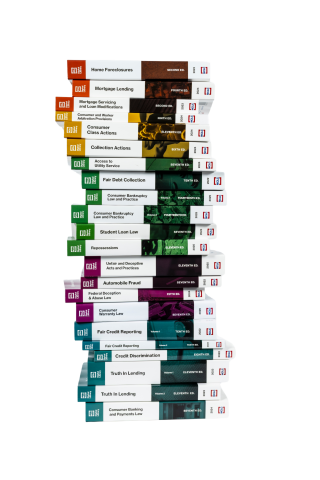
The first chapter of each consumer law treatise is available for free in NCLC's Digital Library.
Click any NCLC title below to start reading now:
Debtor Rights
Fair Debt Collection
Consumer Bankruptcy Law and Practice
Student Loan Law
Repossessions
Access to Utility Service
Mortgages & Foreclosures
Mortgage Lending
Mortgage Servicing and Loan Modifications
Home Foreclosures
Deception & Warranties
Unfair and Deceptive Acts and Practices
Federal Deception Law
Automobile Fraud
Consumer Warranty Law
Credit & Banking
Fair Credit Reporting
Truth in Lending
Consumer Credit Regulation
Credit Discrimination
Consumer Banking and Payments Law
Consumer Litigation
Collection Actions
Consumer Class Actions
Consumer Arbitration Agreements