
Beginning in July 2026, federal student loan repayment options are changing dramatically because of new “RISE” regulations implementing last summer’s reconciliation bill, the One Big Beautiful Bill Act (OBBBA) (Pub. L. No. 119-21, 139 Stat. 72), and also settlement of the litigation in Missouri v. Trump, No. 4:24-cv-00520 (E.D. Mo. Mar. 10, 2026) that resulted in the elimination of the SAVE repayment plan and vacatur of repayment regulations from 2023.
The repayment changes primarily apply to repayment of Direct Loans, which are both the most common type of federal student loan (90% of outstanding federal student loans are Direct Loans) and the only type that has been available to borrow since Federal Family Education Loan Program (FFEL) loans stopped being made in 2010 and Perkins Loans stopped being made in 2018. The impact of these changes on borrowers will differ depending not only on what type of loans the borrower has, but also on whether the borrower consolidates or takes out any new loans on or after July 1, 2026. Key changes for different groups of borrowers are summarized in this article. For more details, visit NCLC’s Student Loan Law, Chapter 3 “Pre-Default Repayment Options,” which has recently been updated online to reflect these major changes.
New Rules Provide Different Options for Legacy Borrowers versus Borrowers Who Take Out Any New Loans After July 1
Under the new rules, a borrower’s options to repay their Direct Loans will depend on whether the borrower has taken out any new Direct Loans—including a new Direct Consolidation Loan made by consolidating existing, older loans—on or after July 1, 2026. This effectively creates two different repayment tracks, each with a different set of repayment plan options available.
The first track is for “new borrowers” after July 2026, including both first-time federal student loan borrowers taking out loans on or after July 1, 2026, and existing borrowers taking out another loan or consolidating their existing loans on or after July 1. New borrowers will not have access to any of the old repayment plan options for any of their Direct Loans and will have to repay all their Direct Loans (including any of their older Direct Loans) using one of two new plans described below.
The second track is for what can be thought of as “legacy borrowers” or “pre-July 2026 borrowers”—i.e., borrowers who took out all of their federal student loans before the new rules went into effect on July 1, 2026, and who do not take out any new loans or consolidate their existing loans after July 1. Legacy borrowers will retain most of their existing repayment options, with some important changes described below.
Only Two Repayment Options for Borrowers Taking Out Any New or Consolidation Loans Starting July 1
If the borrower has one or more new Direct Loans made on or after July 1, 2026, then all their Direct Loans, including those taken out before July 2026, will be limited to the following two repayment options: the Tiered Standard Plan or Repayment Assistance Plan (RAP).
1. Tiered Standard Plan
The Tiered Standard Plan is a new fixed repayment plan that generally has equal monthly payments calculated to fully repay the borrower’s loans by the end of their repayment period. Unlike the Standard plan for legacy borrowers, which is usually set at 10 years, the repayment period in Tiered Standard Plan varies based on the total amount of the borrower’s Direct Loans. Borrowers who have less than $25,000 in Direct Loans at the time they enter repayment must repay within 10 years; those with $25,000 to $49,999 must repay within 15 years; those with $50,000 to $99,999 must repay within 20 years, and those with $100,000 or more must repay within 25 years.
New borrowers who do not request a different repayment plan will automatically be placed in the Tiered Standard Plan when entering repayment but can switch to the RAP plan at any time to repay loans for their own education. Payments in the Tiered Standard Plan do not qualify for Public Service Loan Forgiveness (PSLF).
The Tiered Standard Plan is discussed in detail in § 3.9.2 of NCLC’s Student Loan Law.
2. Repayment Assistance Plan (RAP)
RAP is a new income-driven repayment (IDR) plan, i.e., a plan that sets monthly payments based on income. But RAP’s repayment formula is very different from older IDR plans like Income-Based Repayment (IBR), which set payments at a fixed percentage of borrower’s income in excess of a protected amount based on family size, allowed borrowers with incomes below the protected amount to qualify for $0 payments, and capped payments at the amount the borrower would owe in a standard plan.
Instead, RAP sets monthly payments at between 1% and 10% of total adjusted gross monthly income, minus $50 per dependent, and with a minimum monthly payment of $10 (even if the $50 dependent deduction would bring the amount to under $10), and no upper cap on the size of payments. The percentage of income the borrower is charged depends on their income bracket, with the highest 10% charge applying to borrowers with income over $100,000. See the table below. Borrowers who are married and file taxes jointly will have their payment calculated using their total combined income, which can create a substantial marriage penalty that is only partially offset if their spouse also has federal student loans, in which case the borrower’s payment will be reduced in proportion to their share of the couple’s combined student debt.
| Income range | % of income used to calculate monthly bill | Monthly bill range before subtracting $50 per dependent (with $10 minimum payment after deductions) |
| Less than $10,000 | NA | $10 |
| $10,000–$20,000 | 1% | $10–$16 |
| $20,000–$30,000 | 2% | $33–$50 |
| $30,000–$40,000 | 3% | $75–$100 |
| $40,000–$50,000 | 4% | $133–$166 |
| $50,000–$60,000 | 5% | $208–$250 |
| $60,000–$70,000 | 6% | $300–$350 |
| $70,000–$80,000 | 7% | $408–$466 |
| $80,000–$90,000 | 8% | $533–$600 |
| $90,000–$100,000 | 9% | $675–$750 |
| Greater than $100,000 | 10% | $833+ |
Many, but not all, borrowers will face higher payments in RAP than in older IDR plans, and payments may become relatively higher in RAP over time because its income brackets and dependent deduction are not indexed for inflation. But RAP does have some new benefits: To ensure payments result in balance reduction, RAP waives any monthly interest charges not covered by the borrower’s monthly payment and offers a small principal reduction in months that a borrower’s payment reduces their principal by less than $50.
RAP offers forgiveness of any remaining balance after 30 years of qualifying payments. This is substantially longer than the 20 to 25 years in older plans, though the Department projects that most borrowers will pay off their loans in full in RAP before 20 years.
Like other income-driven repayment plans, payments in RAP are eligible for Public Service Loan Forgiveness (PLSF).
The RAP plan is discussed in detail at § 3.9.3 of NCLC’s Student Loan Law.
Repayment Options for Borrowers Who Took Out All Their Loans Before July 1, 2026
Legacy borrowers, or “pre-July 2026 borrowers,” who do not take out any new loans or consolidate their existing loans after July 1, 2026 will retain most of their existing repayment options—for now—but face some important changes, including the end of the SAVE plan and introduction of the RAP plan.
Starting in July 2026, legacy borrowers will generally have access to the following plans to repay their Direct Loans (though not all borrowers will be eligible for all plans):
- Income-Based Repayment (IBR), an income-driven repayment plan available since 2008, will remain available to legacy borrowers and eligibility has been expanded by eliminating the “partial financial hardship” requirement such that all pre-July 2026 borrowers are eligible for IBR to repay Direct Loans for their own education;
- Repayment Assistance Plan (RAP), the new income-driven repayment plan described above, will become available to both new and legacy borrowers to repay Direct Loans for their own education;
- Standard Plan, a fixed payment plan that typically repays loans in full in 10 years (or up to 30 years for consolidated loans), will remain available;
- Graduated Plan, a plan in which payments increase every two years to repay loans in full in 10 years, will remain available;
- Extended plan, a plan with either standard or graduated payments and an extended repayment period of up to 30 years, will remain available;
- *Pay As You Earn (PAYE)—this income-driven repayment plan remains available for now, and like IBR has slightly expanded eligibility, but will be eliminated in July 2028;
- *Income-Contingent Repayment (ICR)—this income-driven repayment plan remains available for now but will be eliminated in July 2028.
Borrowers enrolled in the SAVE, PAYE, and ICR plans will be the most impacted by the changes, as each of these plans will be fully eliminated by July 2028. The SAVE plan is the first to be eliminated as a result of legal challenges.
The Department of Education has stated that borrowers enrolled in SAVE will receive notices beginning sometime after July 1, 2026 that will advise them that before 90-days from the date of their individual notice, they must enroll in a new repayment plan. Borrowers who do not select and request a new plan will be forced into another plan, likely the Standard Plan, which may have much higher payments.
The end of SAVE will be a dramatic change for many of the approximately 7 million borrowers enrolled in the plan, many of whom qualified for $0 or low monthly payments in SAVE and all of whom have been in a forbearance and have not had to make payments since the summer of 2024. Increased delinquencies and defaults are widely expected because of the elimination of SAVE.
PAYE and ICR remain available for now but will be eliminated in July 2028. Most Direct Loans that were enrolled in PAYE or ICR will be moved to the RAP plan in July 2028 if the borrower does not switch to another plan before that date; the exception is that any Direct Consolidation Loans that repaid Parent PLUS loans that were enrolled in ICR or PAYE will be switched to IBR.
Legacy borrowers considering switching to the new RAP plan should be advised that while payments in other income-driven repayment plans count toward the 30-year forgiveness period in RAP, payments in RAP generally do not count toward the 20 to 25-year forgiveness periods in IBR, PAYE, or ICR.
Impact of Repayment Changes on Borrowers with FFEL Loans
All existing options for repayment of FFEL loans remain. As with Direct Loans, access to IBR is expanding to all FFEL borrowers due to the elimination of the requirement that borrowers must have a “partial financial hardship” to enroll. The new RAP plan will not be available for FFEL Loans, and IBR remains the only income-driven repayment option for FFEL Loans.
However, FFEL loans after July 1 will have to be repaid using one of two new repayment options for new Direct Loan borrowers: RAP or Tiered Standard. This is true for both the new Direct Consolidation Loan and any other Direct Loans the borrower has.
Generally, borrowers can repay their FFEL loans in a different repayment plan than their Direct Loans. However, the new rules complicate using RAP to repay Direct Loans if a borrower also has FFEL loans. While legacy borrowers who repay both their FFEL and Direct Loans in IBR will continue to have their IBR payments for both their Direct and FFEL loans reduced proportionately to account for their payments on their other loan type and prevent “double paying,” the rules do not contain a similar provision to reduce RAP payments to account for any FFEL payment obligations.
Parents Who Borrow Federal Loans for their Children’s Education Face Limited Repayment Options and Must Act Before July 1, 2028 to Access IDR
Parent PLUS loans are federal student loans taken out by parents to pay for their children’s education, and they have never been directly eligible for income-driven repayment plans. However, parents who need lower payments have traditionally been able to access the Income-Contingent Repayment plan (ICR) by consolidating into a Direct Consolidation Loan and repaying it in ICR. This has been a lifeline to many low-income parent borrowers.
Under the new rules, Parent PLUS borrowers will no longer be able to consolidate to access income-driven repayment. Any parents who consolidate Parent PLUS loans on or after July 1, 2026, will have to repay the resulting Direct Consolidation Loan in the Tiered Standard Plan. Similarly, all Parent PLUS loans will have to be repaid in a fixed payment plan, such as the Tiered Standard Plan for new borrowers, and the Standard and Extended plans for legacy borrowers.
Parents who have already consolidated their Parent PLUS loans before July 1, 2026, will still be able to repay their Direct Consolidation Loan using income-driven repayment, but must enroll before July 1, 2028, to do so. Generally, pre-July 2026 Direct Consolidation Loans that repaid a Parent PLUS loan must first enroll in ICR before it is eliminated by July 2028. After at least one payment in ICR, the borrower can switch to IBR, which will remain available even after ICR ends. Consolidated Parent PLUS loans that are still enrolled in ICR when it ends will be automatically switched to IBR.
Additional Changes Beyond Repayment
The federal student loan program has been in dramatic flux since 2020, and changes continue across multiple areas. In addition to the major repayment changes described above, last summer’s OBBB Act and the implementing RISE rules resulted in:
- Making significant changes to how much students and parents can borrow (particularly for graduate and professional students and parent borrowers). While many current students will be grandfathered into old borrowing limits, new students and students changing programs will be subject to the new limits starting July 1, 2026. See NCLC’s A Consumer Practitioner’s Guide to the Reconciliation Bill. Litigation challenging aspects of these new loan limits is underway.
- Rolling back 2022 regulatory protections in the Borrower Defense and Closed School discharge program for borrowers whose schools engaged in harmful misconduct or closed before they could complete. See NCLC’s Student Loan Law § 10.1.
- Making positive changes to rehabilitation of loans out of default, though most changes will not go into effect until next summer (July 1, 2027). See NCLC’s A Consumer Practitioner’s Guide to the Reconciliation Bill.
- For new loans issued on or after July 1, 2027, limit time borrowers can postpone payments using general forbearances and eliminate unemployment and economic hardship deferments. See NCLC’s A Consumer Practitioner’s Guide to the Reconciliation Bill and NCLC’s Student Loan Law at §§ 4.3.5.2, 4.3.5.3, 4.4.1. These changes to deferments and forbearances for new borrowers, combined with the elimination of $0 payment options for new borrowers with no or low income, remove longstanding core protections for low-income borrowers and borrowers who experience job losses or other financial disruptions, and may result in more borrowers becoming delinquent and defaulting when they cannot afford to make payments.
Additionally, separate from the RISE rules:
- New Public Service Loan Forgiveness (PSLF) rules were scheduled to go into effect July 1, 2026 that would have allowed the Secretary of Education to disqualify nonprofit and government employers from PSLF if the Secretary determined that the employer had engaged in certain types of activities that the Secretary deems to have a “substantial illegal purpose” related to discrimination, immigration, terrorism, or transgender youth, or laws relating to state trespassing, public nuisance, disorderly conduct, vandalism, or obstruction. However, these rules have been challenged in multiple lawsuits, and on June 30, 2026 a Massachusetts and a District of Columbia federal district court both granted summary judgment and vacated the new PSLF rules.
- A temporary interest rate reduction for certain Direct Loan borrowers who enroll in autopay goes into effect on July 1, 2026. For more on the autopay interest reduction, see here.

Related Publications

Free First Chapters
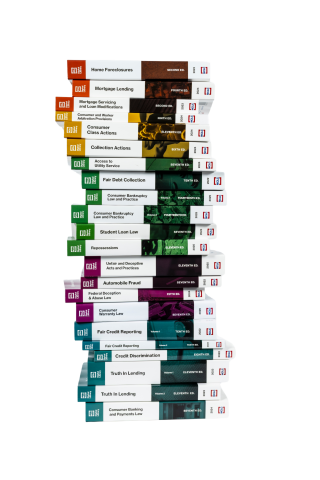
The first chapter of each consumer law treatise is available for free in NCLC's Digital Library.
Click any NCLC title below to start reading now:
Debtor Rights
Fair Debt Collection
Consumer Bankruptcy Law and Practice
Student Loan Law
Repossessions
Access to Utility Service
Mortgages & Foreclosures
Mortgage Lending
Mortgage Servicing and Loan Modifications
Home Foreclosures
Deception & Warranties
Unfair and Deceptive Acts and Practices
Federal Deception Law
Automobile Fraud
Consumer Warranty Law
Credit & Banking
Fair Credit Reporting
Truth in Lending
Consumer Credit Regulation
Credit Discrimination
Consumer Banking and Payments Law
Consumer Litigation
Collection Actions
Consumer Class Actions
Consumer Arbitration Agreements