
On May 14, 2026, the Supreme Court decided yet another arbitration issue in Jules v. Andre Balazs Properties, 2026 WL 1336216 (U.S. May 14, 2026). The decision finds federal jurisdiction to vacate, modify, or confirm an arbitration award for a case that was initially brought under federal question jurisdiction and was stayed after compelling arbitration. But related Supreme Court decisions create a very different standard for cases that are not first filed in federal court or where a federal court dismisses the action after sending the case to arbitration.
Whether there is federal jurisdiction to review an arbitration award has significant implications for the outcome of the case. Because state law generally applies to state courts reviewing arbitration awards, the choice of court determines whether state or federal law applies to the timing, procedures, and even substantive standards in a proceeding to review an arbitration award. See “Top Five Reasons State Court Review of Arbitration Awards Can Make a Difference” (discussed below).
This article reviews Supreme Court standards that determine if such actions are properly brought in federal or state court, surveys differences between Federal Arbitration Act (FAA) and state procedures and standards to vacate, modify, or confirm an award depending on which court reviews the arbitration award, and explains why these issues are of increasing significance to consumer attorneys.
Growing Importance of Review of Arbitration Awards in Consumer Cases
The question as to what court and what law applies to review an arbitration award is of importance to consumers as consumer attorneys increasingly turn to arbitration. This may be the best remaining option to resolve a client’s claims where an arbitration requirement blocks access to the courts or where the time and resources to litigate the enforceability of an arbitration provision may make such litigation impractical.
Proceeding in arbitration even has some advantages. For example, neither federal nor state court standing requirements should apply to a private arbitration proceeding. AAA and JAMS puts almost all the high arbitration costs on the business, not on the consumer. Due process standards should not be applicable to limit the size of a punitive damages award in a private proceeding. Defendants may balk at high arbitration fees and refuse to arbitrate, offering consumers a chance to litigate in court where the court would otherwise have found the arbitration provision enforceable. See NCLC’s 10 Reasons to Give Arbitration a Chance When Blocked from Court (Apr. 18, 2025).
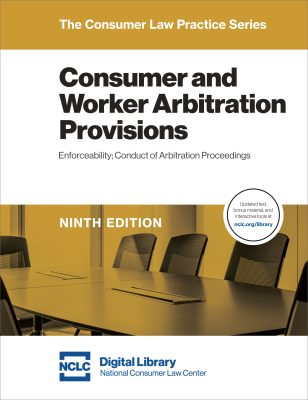
For detailed, winning practice tips in the conduct of every aspect of an arbitration proceeding, see NCLC’s Consumer and Worker Arbitration Provisions Ch. 9.
When cases do go to arbitration, issues of review of an arbitration award often arise. People losing an arbitration may wish to seek court review. People winning in arbitration may face defendant actions seeking to vacate the award. Any award is unenforceable until a court confirms it. For more information on vacating, modifying, and confirming arbitration awards, see NCLC’s Consumer and Worker Arbitration Provisions Ch. 11.
The Supreme Court Decision in Jules
Standards for determining federal court jurisdiction to review an arbitration provision depend on how the arbitration proceeding is initiated. A consumer can initiate an arbitration proceeding without first filing a court action, a state court can order a case be sent to arbitration, or a federal court can dismiss a court action to enforce an arbitration requirement. Jules deals with a fourth option—where a federal court stays a federal case pending arbitration.
Where a federal court stays a federal case pending arbitration, a unanimous Supreme Court in Jules ruled that the federal court retains jurisdiction while the case is stayed, and that court then has federal jurisdiction to review the arbitration award. The court’s federal jurisdiction arises not from the FAA, but from its jurisdiction to hear the case originally and its retention of that jurisdiction for later proceedings in the same case while the case is stayed pending arbitration. As described in the next section, if a federal court relinquishes jurisdiction—for instance, because it dismisses the claim after issuing an order compelling arbitration—Jules does not apply, and it is far less likely for there to be federal jurisdiction to review a resulting arbitration award.
Other Supreme Court Decisions Where Jules Does Not Apply
If an arbitration is initiated other than after a federal court stays the case pending arbitration, different Supreme Court standards apply. The 2022 Supreme Court decision in Badgerow v. Walters, 596 U.S. 1 (2022), sharply limits when there is federal jurisdiction to vacate, modify, or confirm an arbitration award in these other situations.
In Badgerow, a worker initiated arbitration that included a federal claim, but the worker did not first file the case in court. The losing worker sought to vacate the case in state court and the defendant removed the action to federal court. The Badgerow Court held that there was no federal jurisdiction to hear the action to vacate the award. Diversity jurisdiction did not exist and the question before the Court in the action to vacate was not the federal claim that was heard in the arbitration proceeding, but the state law contract issue of whether the private award for the employer was a binding contract. As the Badgerow Court reasoned:
And their applications raise no federal issue. Recall that the two are now contesting not the legality of Badgerow’s firing but the enforceability of an arbitral award. That award is no more than a contractual resolution of the parties’ dispute—a way of settling legal claims. See Vaden, 556 U. S., at 63. And quarrels about legal settlements—even settlements of federal claims—typically involve only state law, like disagreements about other contracts. See Kokkonen, 511 U.S., at 378–382.
Moreover, bringing an action pursuant to the FAA to review an arbitration award is not an independent or sufficient basis for federal question jurisdiction—there must be some other basis. Jules reaffirms this finding previously enunciated in both Badgerow and Vaden v. Discover Bank, 556 U.S. 49 (2009)—the mere fact that review is pursuant to the FAA is not an independent basis for federal jurisdiction.
Badgerow distinguishes itself from the Supreme Court decision in Vaden, which dealt with a federal court’s jurisdiction under FAA § 4 to enforce an arbitration provision where the action was in state court. In that case, the Court found federal jurisdiction looking through the FAA § 4 action to the underlying state case, where there was federal jurisdiction in the state case based on complete preemption.
Badgerow holds that this “look-through” standard applies to actions to enforce an arbitration requirement, but not to review an arbitration award. Federal jurisdiction to review an award (other than one in Jules initiated after a federal court had stayed the federal case) must be based upon the issues in front of the court in the action to review the award, not the issues in the underlying arbitration.
The Badgerow analysis instead of the Jules analysis should apply to review of arbitration awards where a court action was never filed, where the action was initiated in state court and sent to arbitration without having been removed to federal court, or where a federal court action was dismissed, not stayed, and so is no longer before the federal court. The logic behind Jules is that a federal court in staying an action has retained jurisdiction. This is not the case where the action was only heard in state court prior to arbitration, was remanded to state court after removal, or where a federal court has dismissed the case.
Federal courts typically stay arbitration cases and do not dismiss them. In Smith v. Spizzirri, 601 U.S. 472 (2024), the Supreme Court held that if either party requests a federal case be stayed pending arbitration, then the court has no discretion to dismiss the case but must stay the case. Nevertheless, where a federal court has enforced an arbitration requirement, and the defendant has not requested the court stay the case pending arbitration, a consumer wishing for state court review should request the case be dismissed, not stayed. Then Badgerow applies, not Jules.
Diversity Jurisdiction
The Supreme Court has not ruled on how to compute the amount in controversy when a review of an arbitration award is brought in federal court. When other courts compute the amount in controversy to establish diversity jurisdiction for an action to vacate or modify, courts find the amount at stake is neither the amount at issue in the underlying litigation nor the amount of the arbitration award. What is determinative is the amount at stake in the judicial review—that is, the monetary difference depending on whether the judicial action to vacate or modify is successful. See generally NCLC’s Consumer and Worker Arbitration Provisions § 11.2.1.
When a plaintiff brings an action to vacate an award and seek a new arbitration because the award is inadequate, diversity jurisdiction is based on the additional amount the plaintiff is seeking, not on the amount of the award. If the defendant seeks to vacate an arbitration award for the plaintiff that is for less than $75,000, there is no diversity jurisdiction. Of course, in an action to confirm, the total amount of the award is at issue and should determine the diversity amount.
When federal jurisdiction is based on diversity of the parties, the FAA’s procedures as to review should apply in federal courts, but courts have held that state law standards govern the substance of the review, if those standards are at least as protective of the arbitration award as the FAA. See NCLC’s Consumer and Worker Arbitration Provisions § 11.2.2.
Top Five Reasons State Court Review of Arbitration Awards Can Make a Difference
Whether a consumer presses for or objects to federal court jurisdiction to review an arbitration award often depends on the difference between federal and state procedures and standards for such review. Here are five top reasons there can be a difference:
- Judges and an expeditious hearing. Depending on the state, consumer attorneys may prefer state or federal judges, or a state court case may proceed more or less expeditiously.
- Deadline to vacate an award. The FAA allows a party to vacate an award only if filed within three months of issuance of the award. Most states similarly set a ninety-day deadline, but Connecticut, Maryland, Pennsylvania, and Massachusetts provide only thirty days to vacate an award, Michigan allows only twenty-one days, and Alabama has a complicated procedure which requires a party to initiate a proceeding within forty-two days after notice of the award. On the other hand, New Hampshire provides for one year. California provides for one hundred days. In Arizona, a party seeking to modify an arbitration award must do so within ninety days, but no similar deadline exists for motions to set aside the award in its entirety. Oregon provides that one can seek to vacate an arbitration award within twenty days after the collector files the confirmation action. See NCLC’s Consumer and Worker Arbitration Provisions § 11.2.4.1.
-
Grounds to vacate an arbitration award on the merits. Even among the federal circuits, there is disagreement as to whether manifest disregard of the law is an independent ground to vacate an arbitration award and how to apply the manifest disregard standard. See NCLC’s Consumer and Worker Arbitration Provisions § 11.5.1.
There is even more variation among the states. For example, New Hampshire courts allow a party to vacate an award for plain mistake if the court determines that an arbitrator misapplied the law to the facts. Illinois allows a court to vacate an arbitration award where a gross error of law or fact appears on the award’s face. Connecticut’s Supreme Court recognizes public policy as a basis to vacate an award, when an award violates an explicit, well-defined, and dominant policy. A Georgia statute explicitly lists manifest disregard of the law as a ground to vacate an award. Other state standards often depart from the standards set in the federal circuit applicable to that state. See NCLC’s Consumer and Worker Arbitration Provisions § 11.5.1.
-
Contractual Provisions Heightening Grounds to Vacate an Award. The Supreme Court in Hall Street Associates, L.L.C. v. Mattel, Inc., 552 U.S. 576 (2008), ruled that the FAA prohibits parties from contracting for a heightened level of federal judicial review of the merits of an arbitration award. Thus, a consumer contract cannot instruct a federal court to review an arbitration award for errors of law, to determine if the award was supported by evidence, or to allow de novo judicial review.
State courts are not bound by this ruling. While some state courts have reached the same conclusion as Hall Street Associates, the California and Texas Supreme Courts have ruled, after Hall Street Associates was decided, that state courts are not bound by the Supreme Court’s interpretation of the FAA when interpreting state arbitration law, and that under state law the parties were free by contract to expand the nature of judicial review. See NCLC’s Consumer and Worker Arbitration Provisions § 11.2.6.2.
-
Deadline to confirm an arbitration award. There is confusion as to the deadline to confirm an arbitration award. FAA § 9 states that a party “may” seek to confirm an award in federal court within one year of that award, and federal courts come to differing conclusions as to whether the one-year period requires strict compliance.
State court timing rules to confirm are even less clear. Neither the Uniform Arbitration Act (UAA) nor the revised UAA establish time limits to confirm an award, although the revised UAA § 22 cmt. 2 provides that states should use their general statute of limitations for the filing and execution of a judgment in a state. For example, D.C. uses three years. California by statute has a four-year limit. However, other states follow the FAA and use one year. Like federal FAA case law, states come to differing conclusions as to whether the applicable time limit is mandatory. See NCLC’s Consumer and Worker Arbitration Provisions § 11.2.4.2.
FAA Should Not Preempt State Law as to Review of Arbitration Awards
In general, the FAA does not preempt state laws and state court interpretations of state law concerning standards to vacate, modify, or confirm an arbitration award. There is preemption only when state standards conflict with the enforceability of the arbitration agreement. FAA provisions regarding review of arbitration awards explicitly apply only to federal courts, not to state courts, so there is no direct conflict between a standard applicable to federal courts and one applicable to state courts. The FAA preempts state laws concerning the enforceability of arbitration agreements, not arbitration awards.
There is even less likelihood that the FAA preempts state procedures than state substantive review standards. The Supreme Court in Volt Information Sciences, Inc. v. Board of Trustees, 489 U.S. 468, 476 (1989) has held that “[t]here is no federal policy favoring arbitration under a certain set of procedural rules.”
Some courts find that the FAA applies to state court review of arbitration awards, not because of preemption, but because the arbitration provision specifies that arbitration will be pursuant to the FAA. But a majority of courts have ruled that state law applies even when the agreement mentions the FAA. Moreover, FAA §§ 10 and 11 on vacating and modifying awards explicitly apply only to federal courts, stating that “in any of the following cases the United States court in and for the district wherein the award was made may make an order.” Thus, arbitration review consistent with the FAA does not require FAA procedures to vacate or modify an award—those procedures only apply to federal court.


Related Publications
Free First Chapters
The first chapter of each consumer law treatise is available for free in NCLC's Digital Library.
Click any NCLC title below to start reading now:
Debtor Rights
Fair Debt Collection
Consumer Bankruptcy Law and Practice
Student Loan Law
Repossessions
Access to Utility Service
Mortgages & Foreclosures
Mortgage Lending
Mortgage Servicing and Loan Modifications
Home Foreclosures
Deception & Warranties
Unfair and Deceptive Acts and Practices
Federal Deception Law
Automobile Fraud
Consumer Warranty Law
Credit & Banking
Fair Credit Reporting
Truth in Lending
Consumer Credit Regulation
Credit Discrimination
Consumer Banking and Payments Law
Consumer Litigation
Collection Actions
Consumer Class Actions
Consumer Arbitration Agreements