
Telephone Consumer Protection Act (TCPA) litigation—with statutory damages of $500 per violation ($1,500 if willful or knowing) per illegal call—remains one of the hottest areas of consumer law today. This article advises practitioners how best to pursue such litigation in today’s environment of constantly shifting TCPA law. A 2025 Supreme Court decision, holding that courts no longer are bound to follow Federal Communications Commission (FCC) rules and interpretations and can consider anew many previously settled issues, has only increased the pace of changes in TCPA law.
The article focuses on four of the most current and important issues: whether the TCPA even applies to text messages now, whether the consumer’s prior consent to calls must be in writing (including the implications for digital consent), whether there is a private right of action for telemarketing calls that fail to comply with caller ID rules, and whether remedies for do-not-call list violations apply to cell phones.
Don’t Assume TCPA Private Remedies Apply to Text Messages
A recent Seventh Circuit decision, Steidinger v. Blackstone Med. Services, 182 F.4th 532 (7th Cir. 2026), has complicated TCPA litigation by finding that text messages cannot be considered telephone calls for purposes of certain provisions of the TCPA. Though in previous cases the court has treated a text message as a call subject to the TCPA. See Warciak v. Subway Rests., Inc., 949 F.3d 354, 356 (7th Cir. 2020). See also, e.g., Douglas v. Western Union Co., 955 F.3d 662, 663 (7th Cir. 2020). This finding, if followed by other courts outside the Seventh Circuit, would restrict plaintiffs receiving unwanted texts to only one of the TCPA’s two causes of actions, TCPA § 227(b). Moreover, the Supreme Court has also limited the application of TCPA § 227(b) by significantly restricting the types of dialing technology that are covered.
The TCPA grants two private causes of action. First, 47 U.S.C. § 227(b)(3) provides the right to seek an injunction or damages, or both, for a violation of the TCPA’s prohibition on making an autodialed or prerecorded or artificially voiced message “call” to certain protected types of phone lines or for violations of FCC rules promulgated under section 227(b). This private cause of action now has far less application to text messages after a 2021 Supreme Court decision sharply limited the type of equipment which qualifies as an autodialer under the TCPA. See Facebook, Inc. v. Duguid, 592 U.S. 395 (2021). See also NCLC’s Federal Deception & Abuse Law § 6.4.3.
Several courts including the Second and Ninth Circuits have held that a text message is generally not considered an artificial or prerecorded voice, and so only the autodialer provisions of section 227(b) (as sharply limited by the Supreme Court) would be relevant to text message cases. See NCLC’s Federal Deception & Abuse Law § 6.3.2.
In addition, the great weight of court decisions also holds that the TCPA’s private remedy provision in section 227(b) applies to text messages, including decisions from the Second, Third, Sixth, Ninth, and Eleventh Circuits. See NCLC’s Federal Deception & Abuse Law § 6.3.1.1.2.
The second private cause of action under the TCPA, 47 U.S.C. § 227(c)(5), is available to “[a] person who has received more than one ‘telephone call’ in violation of the FCC’s do-not-call rules and other regulations promulgated under section 227(c). 47 U.S.C. § 227(c)(5). The FCC has repeatedly found that the words ‘call’ and ‘telephone call’ in the TCPA include text messages. See, e.g., 38 F.C.C. Rcd. 404, at ¶ 3 (F.C.C. Jan. 23, 2023); 18 F.C.C. Rcd. 14014, at ¶ 165 (F.C.C. July 3, 2003); 47 C.F.R. § 64.1200(e) (do-not-call requirements apply to texts).
Surprisingly then, on July 14, 2026, the Seventh Circuit held in Steidinger v. Blackstone Med. Services, 182 F.4th 532 (7th Cir. 2026), that the term “telephone call” in the private cause of action in section 227(c)(5) does not include text messages. Relying on the Supreme Court’s holding in McLaughlin Chiropractic Associates, Inc. v. McKesson Corp., 606 U.S. 146 (2025), that the FCC’s TCPA rules and interpretations no longer bind courts, the court dismissed the FCC interpretations and its prior holdings regarding section 227(b).
Steidinger held that, at the time of enactment of the TCPA, the term “telephone” was a device that had just the capacity to reproduce “sounds at a distance,” so Congress must have intended the term “telephone call” to refer to communication by sound. This ruling would effectively render a text message a “call” subject to the private cause of action in section 227(b)(3) but not a “telephone call” for purposes of the private cause of action in section 227(c)(5). See NCLC’s Federal Deception & Abuse Law § 6.2.5.1.2.
As a result, practitioners in the Seventh Circuit should avoid TCPA text messaging claims under section 227(c)(5). Outside the Seventh Circuit, despite Steidinger, litigants should be able to seek TCPA private remedies under both sections 227(b)(3) and 227(c)(5) for text messaging violations. Practitioners should, however, be cautious about the cases they choose to file, as courts may be more likely to embrace Steidinger’s spurious distinction between “calls” which include text messages and “telephone calls” which do not, as a way of disposing cases they perceive as otherwise lacking merit. See NCLC’s Federal Deception & Abuse Law § 6.3.1.1.2.
Why the TCPA Should Apply to Text Message Cases
The Second, Third, Sixth, Ninth, and Eleventh Circuits have found that, under the TCPA, text messaging counts as a “call,” and these decisions should be binding on courts in those circuits, at least with respect to claims brought under section 227(b)(3), and should provide strong footing to argue that TCPA § 227(c) also covers text messages in those Circuits. As for the numerous FCC interpretations applying the TCPA provision to text messages—while such interpretations are not binding on the courts—consistent rulings for over twenty years by the expert body on the TCPA should carry some weight with a court.
Practitioners who pursue text message cases can argue that Steidinger’s distinction between “call” and “telephone call” makes little intuitive sense and is at odds with the structure and purpose of the TCPA. In TCPA § 227(a)(4), the definition of “telephone solicitation” includes “the initiation of a telephone call,” but expressly excludes a “call” with the prior express invitation or permission of the recipient. If Congress intended “telephone call” and “call” to have different meanings, it would not have used the two synonymously in the same sentence.
Additionally, interpreting “telephone call” in section 227(c)(5) to exclude text messages would undermine the TCPA as a statute designed to protect consumer privacy. As one court put it, “[i]t cannot be argued in good faith that text messages are so categorially different from phone calls that the former cannot be considered an invasion of consumer privacy when directed at numbers on the DNC Registry.” Wilson v. Skopos Fin., L.L.C., 2025 WL 2029274 (D. Or. July 21, 2025). See NCLC’s Federal Deception and Abuse Law § 6.3.1.1.5.
Moreover, Congress, in enacting the TCPA, applied private remedies for violations of provisions relating to pagers. If the term “call” did not encompass delivery of a message consisting of alphanumeric characters, Congress’s prohibition of “any call ... to a telephone number assigned to a paging service” would be meaningless. See NCLC’s Federal Deception & Abuse Law § 6.3.1.1.3. Messages on a pager are essentially the same thing as text messages—they both involve alphanumeric messages, not voice transmission. Steidinger acknowledged that private TCPA remedies are available for violations related to pagers but did not explain how the court distinguished text messages from messages on pagers.
In addition, in 2019, Congress unambiguously endorsed the FCC’s inclusion of texts as “calls” by enacting the TRACED Act. That Act required the FCC to issue regulations to facilitate information-sharing regarding “a call made or a text message sent in violation of subsection (b).” Since “subsection (b)” applies only to “calls,” text messages can be sent “in violation of subsection (b)” only if they are considered calls. See NCLC’s Federal Deception & Abuse Law § 6.3.1.1.4.
Similarly persuasive are definitions of “call” found in dictionaries at the time Congress enacted the TCPA in 1991. At least three widely circulated dictionaries available in 1991 or shortly thereafter defined the verb “call” in operative part as “an attempt to communicate by telephone.” There was no requirement that a call allow real-time, two-way voice communication. Indeed, at the time the TCPA was adopted, telephones could already send alphanumeric messages to pagers, and telephones could send, receive, and display Caller ID information. Neither of these functions involves voice communication. See NCLC’s Federal Deception & Abuse Law § 6.3.1.1.5.
Fifth Circuit Invalidates Written Consent Regulation
TCPA § 227(b) prohibits making non-emergency calls “using any automatic telephone dialing system or an artificial or prerecorded voice” to a cell phone or prerecorded or artificial voice calls to a residential line absent “prior express consent of the called party.” The statute is silent on the definition of “express consent,” but gives the FCC authority to adopt regulations implementing this prohibition. An FCC regulation requires that, if such a call is for telemarketing purposes, the consent must be written. 47 C.F.R. § 64.1200(a)(2); NCLC’s Federal Deception & Abuse Law § 6.4.5.1 (for cell phones); id. § 6.5.5 (for residential lines). Importantly, the FCC’s regulation allows for written consent to include any form of consent that complies with state or federal laws, such as the E-Sign Act, allowing electronic records to function as a writing. This would allow recorded oral consent to satisfy the written consent requirement.
In March 2026, however, the Fifth Circuit in Bradford v. Sovereign Pest Control of TX, Inc., 167 F.4th 809 (5th Cir. 2026), held that the written consent regulation, 47 C.F.R. § 64.1200(a)(2), is invalid, including without discussion the E-Sign requirements, and only the undefined “prior express consent” is required regardless of whether the call constitutes telemarketing.
As with the Seventh Circuit in Steininger, the Fifth Circuit in Bradford viewed itself not bound by the FCC regulations, pursuant to McLaughlin. Instead, relying on contemporaneous definitions from Black’s Law Dictionary, the court found that prior express consent encompasses both oral and written consent. The Eleventh Circuit had also questioned in dicta whether the TCPA required written consent. See Insurance Marketing Coalition Limited v. Fed. Communications Comm’n, 127 F.4th 303, 312, 318 (11th Cir. 2025).
These courts failed to recognize that the “written” consent required under the FCC’s regulations can be given in forms other than a paper and ink writing. In promulgating the written consent regulation, the FCC stated: “consent obtained in compliance with the E-SIGN Act will satisfy the requirements of our revised rule, including permission obtained via an email, website form, text message, telephone keypress, or voice recording.” In the Matter of Rules & Regulations Implementing the Tel. Consumer Prot. Act of 1991, 27 F.C.C. Rcd. 1830, 1844, at ¶ 34 (2012) (emphasis supplied).
The court in Bradford mistakenly concluded that a section of the definition in the 1990 version of Black’s Law Dictionary which states “express consent” means consent that is “directly given, either viva voce or in writing” renders the written consent requirement inconsistent with the plain language of the TCPA. Bradford, 167 F.4th at 812. “Viva voce” means “with the living voice; by word of mouth.” Id. However, as the written consent regulation allows for consent to be given in any manner that satisfies the E-Sign Act, including oral recordings, the regulation is consistent with the cited definition.
Of course, Bradford is not binding in other circuits and Insurance Marketing Coalition is only dicta. In addition, while courts are not bound by FCC regulations, the rules are persuasive in that the FCC is the expert agency interpreting the TCPA. Moreover, even the Fifth Circuit’s decision addresses only autodialed and prerecorded calls (TCPA § 227(b)); it does not address calls to numbers on the national Do-Not-Call registry. The TCPA explicitly delegates particularly broad rulemaking authority to the FCC regarding do-not-call requirements, so those claims are probably still safe even in the Fifth Circuit.
Regardless of the form in which consent is given, the defendant has the burden of proving that a consumer actually consented to receive calls, orally or otherwise. Adequate proof might be where an oral consent was recorded—assuming a recording over the telephone is consistent with state law. Otherwise, it will be a matter of credibility of witnesses and the context of the discussion, like any dispute regarding an oral agreement.
Proving Digital Consent
FCC rules require that the prior express consent to receive prerecorded telemarketing calls on a cell phone or a residential line be a written agreement, signed by the consumer, containing certain specific disclosures. 47 C.F.R. § 64.1200(f)(9). Because the agreement must be in “writing,” the federal E-Sign Act, 15 U.S.C. § 7001, et seq., requires that certain consumer consent provisions must be met before a consumer can replace “written” consent with digital consent to calls. These requirements are set out in NCLC’s Federal Deception & Abuse Law § 6.4.5.2. Failure to comply invalidates any electronic consent.
If a court were to follow Bradford and find that the FCC’s written consent requirement is invalid, then digital consent need not comply with the E-Sign consumer consent provisions. Nevertheless, there are often other grounds to challenge digital consent to calls.
Too often courts and even plaintiffs acquiesce to a defendant’s minimal evidence that a consumer consented to calls by taking an action on a website or signing an electronic device during a transaction conducted in person. At least four reasons may defeat such evidence of digital consent: it was not the consumer visiting a website, the language granting consent to calls may not have appeared on the website at the time of the consumer’s visit, the consumer’s actions on the website did not indicate consent to calls, and a link on the site to consent to calls was not conspicuous or clear.
There are several possible reasons why a consumer was in fact not the person giving digital consent. An identity thief could have visited the site. A marketer could have used bots and “human click farms” to enter data the consumer supplied from one site into a second website that the consumer has never visited. Marketers have an incentive to do so where they are paid by website clicks to drive customers to the second website. During an in-person transaction, a business could have forged the consumer’s Docusign signature. See NCLC’s Federal Deception & Abuse Law § 6.4.5.2.1; NCLC’s Consumer and Worker Arbitration Provisions § 4.3.4.2.
Also don’t assume that website content presented by the defendant is identical to the site’s content on the day the consumer visited the site. One way of checking this is to use the Internet Archive’s “Wayback Machine” to see if the content the business produced matches the version that the Wayback Machine recorded on the date the individual is said to have visited the site. See, e.g., Newell v. LendVia, L.L.C., 2025 WL 2380706 (E.D. Pa. Aug. 15, 2025) (alleging the business produced the wrong version based upon the version produced by the Wayback Machine).
Instructions for use of the “Wayback Machine” are found online as a “Practice Tool” accompanying NCLC’s Federal Deception Law, Using Archive.org to Locate the Version of Contract Terms as of Given Date. See also NCLC’s Consumer and Worker Arbitration Provisions § 4.3.4.1a.
The defendant must also show that the action the consumer took on the site could reasonably be considered as consent to calls, even if that consent was found in the site’s terms and conditions or elsewhere linked from or on the site. The action on the site may be providing contact information or agreeing to a free product or service or purchasing a product. There must be a close relationship between the action on the site and the consumer’s intent to consent to calls. For example, there is no consent to calls where the website’s mention of consent to calls is found pages away from a submit button to purchase a product and where the submit button does not refer to consent to calls or terms and conditions containing such consent. See NCLC’s Federal Deception & Abuse Law § 6.4.5.2.1; NCLC’s Consumer and Worker Arbitration Provisions § 4.3.4.1.
Even if the action on the site is near a link leading to consent to calls, that link must be conspicuous and the language of the link and the consent to calls must be clear. See NCLC’s Federal Deception & Abuse Law § 6.4.5.2.1; NCLC’s Consumer and Worker Arbitration Provisions § 4.3.4.1.
The TCPA defendant must prove the same aspects of consent when it claims that the consumer has entered into a binding arbitration provision.
Private Remedies for Telemarketing Calls Violating Caller ID Rules
Too often courts and practitioners assume there are no private TCPA remedies when a telemarketer violates caller ID requirements, just because the Truth in Caller ID Act does not provide for a private right of action. See NCLC’s Federal Deception & Abuse Law § 7.2.6.
But the FCC’s caller ID rules, 47 C.F.R. § 64.1601(e), which require telemarketers to transmit caller ID information and prohibit them from blocking its transmission, were adopted in 2003 as part of the do-not-call rule, seven years before enactment of the Truth in Caller ID Act. See 68 Fed. Reg. 44,144, 44,179 (July 25, 2003).
The FCC’s caller ID rules were enacted pursuant to 47 U.S.C. § 227(c), which allows a private right of action for violations, if a consumer receives more than one telemarketing call within twelve months. See, e.g., Weingrad v. Dabella Exteriors, L.L.C., 2026 WL 496609 (D. Or. Feb. 23, 2026); Barton v. Am. Family Life Assurance Co., 2026 WL 177598, at *7 (W.D. Wash. Jan. 22, 2026); NCLC’s Federal Deception & Abuse Law § 7.2.6.
A caller ID violation can also be viewed as a violation of 47 C.F.R. § 64.1200(d)(4), which requires any caller making a call for telemarketing purposes (or making certain non-telemarketing prerecorded calls) to provide identification information. Many courts have held that the private cause of action provided by TCPA § 227(c)(5) is available for violation of this regulation. See NCLC’s Federal Deception & Abuse Law § 7.2.4.
New Case Law on Whether the Do-Not-Call Rule Applies to Cell Phones
Extensive case law finds that the FCC’s Do-Not-Call (DNC) Rule applies to calls to most cell phones, by virtue of a presumption that cell phones registered on the DNC list are “residential” telephones. See NCLC’s Federal Deception & Abuse § 6.6.3.2.5. This should be the case even if the consumer’s landline, not their cell phone, is their primary phone. See 18 F.C.C. Rcd. 14014, at ¶ 35 (F.C.C. July 3, 2003).
The Ninth Circuit has held that a defendant may overcome the presumption that a cell phone is a residential line, based on how a plaintiff holds out the phone number to the public: whether the plaintiff’s phone is registered with the phone company as a residential or business line; how much the plaintiff uses the phone for business or employment; who pays the phone bills; and whether the plaintiff has placed the number on the nationwide do-not-call list. Chennette v. Porch.com, Inc., 50 F.4th 1217 (9th Cir. 2022). But it is the defendant’s burden to overcome this presumption.
Nevertheless, some older district courts have held or stated that the FCC exceeded its statutory authority when it applied its nationwide do-not-call rule to cell phones that are used as residential phones, because the law authorizing the FCC’s do-not-call rule does not mention cell phones. After the Supreme Court decision in McLaughlin holding courts no longer are bound by FCC interpretations, it would not be surprising if defendants increasingly make similar arguments.
But the law authorizing the DNC rule, while not mentioning cell phones, does not mention landlines either. Recent case law consistently upholds the FCC view that the DNC rule generally applies to cell phones since they are presumed to have a residential use. See Showers v. Pelican Inv. Holdings Grp., L.L.C., 830 F. Supp. 3d 743, 2026 WL 251730 (S.D. Ill. Jan. 30, 2026); Radvansky v. 1-800-Flowers.com, Inc., 2026 WL 456919 (N.D. Ga. Feb. 17, 2026); NCLC’s Federal Deception & Abuse § 6.6.3.2.5 (citing cases).

Related Publications
Free First Chapters
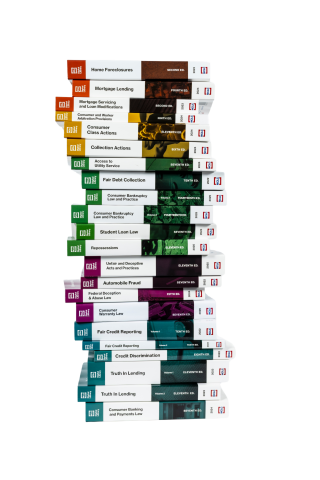
The first chapter of each consumer law treatise is available for free in NCLC's Digital Library.
Click any NCLC title below to start reading now:
Debtor Rights
Fair Debt Collection
Consumer Bankruptcy Law and Practice
Student Loan Law
Repossessions
Access to Utility Service
Mortgages & Foreclosures
Mortgage Lending
Mortgage Servicing and Loan Modifications
Home Foreclosures
Deception & Warranties
Unfair and Deceptive Acts and Practices
Federal Deception Law
Automobile Fraud
Consumer Warranty Law
Credit & Banking
Fair Credit Reporting
Truth in Lending
Consumer Credit Regulation
Credit Discrimination
Consumer Banking and Payments Law
Consumer Litigation
Collection Actions
Consumer Class Actions
Consumer Arbitration Agreements