
On June 23, 2026, the Supreme Court decided another property tax foreclosure issue in Pung v. Isabella County, 2026 WL 1791309 (U.S. June 23, 2026), just over three years since its groundbreaking decision in Tyler v. Hennepin County, 598 U.S. 631 (2023). Pung addresses the measure of just compensation under the Takings Clause and limits it to the surplus at tax sale if the tax sale was "properly conducted."
In Tyler, the Court held that when a local government takes a home at a property tax foreclosure and keeps the homeowner’s equity after the tax debt is paid, it violates the Takings Clause of the Fifth Amendment. Pung had the potential to expand the Takings Clause remedy for homeowners who face a total home loss at tax foreclosure, by deciding whether they are entitled to more than the sale proceeds from a public auction as “just compensation.” Instead, the Court concluded that the “proper baseline” for compensation under the Takings Clause is the price obtained at a tax sale of the property, “at least when the sale is fairly conducted in light of our country’s history of tax sales.”
This article discusses the implications of the Pung decision, exploring when a tax sale may not be “fairly conducted,” which should help advocates determine the types of challenges to their state tax foreclosure procedures that remain after both Tyler and Pung. The article also identifies states where tax sales may still result in an unconstitutional taking and provides arguments to assist advocates in defending legislative gains won after Tyler, and in seeking new law reforms.
Compelling Facts Prompt Court Review
By all accounts, the grant of certiorari in Pung was a head-scratcher. There was no circuit split on the key issue presented. The decision to hear the case it seems was driven by the compelling facts, particularly for two justices who filed a concurring opinion.
As the home passed from heir to heir, the Pung family was entitled to the Michigan primary residence tax exemption, but the local tax assessor retroactively denied the exemption for a three-year period, based on the mistaken belief that the heirs needed to file an updated exemption application and residency affidavit. The Pungs successfully challenged the assessor’s actions in court, but the tax assessor took the position that the judgment did not vacate the tax bill for one of the years, leaving a $2,241 amount owing.
The county quickly proceeded with a tax foreclosure, with evidence suggesting that the county’s actions were retaliatory. While the Pungs initially got an order vacating the foreclosure judgment, the county appealed and was given approval to sell the home, which was assessed at $194,400. The Pung home sold at auction for $76,008. The auction purchaser later sold the home for $195,000.
Because the auction occurred before Michigan law had changed to comply with the Tyler decision, the county kept the sale proceeds. The Pungs sued in federal court to recover their lost equity. The lower courts held there was a Takings Clause violation but awarded damages only for the difference between the auction sale price of $76,008 and the tax debt owed of $2,241. The Pungs were not compensated for the fact that the home valued at $195,000 only sold for $76,008. The Pungs sought review by the Supreme Court, arguing that the compensation awarded was inadequate.
Supreme Court Decides What Is “Just Compensation”
The first question before the Court was whether the measure of “just compensation” under the Takings Clause after a tax taking should be based on the price obtained for the property at a tax sale or its hypothetical fair market value. The Court relied upon historical analysis, noting that governments have seized property for unpaid taxes since the time of the Magna Carta. In doing so, governments have typically given back to the former owner the difference between the proceeds at the tax sale and the tax debt, referred to as the “overplus.”
Early federal and state laws in this country adopted this method of compensation. The Court specifically referred to a leading treatise that surveyed state tax sale laws shortly after the ratification of the Fourteenth Amendment, which found that all states refunded the surplus if bidding exceeded the tax debt. T. Cooley, Law of Taxation 343 (1876).
The Pungs argued that the Court should look to its precedent in eminent domain cases, which create as a default that just compensation be based on fair market value. Knick v. Township of Scott, 588 U. S. 180, 190 (2019). The Pung Court found that tax sales are not like eminent domain cases in which a government seizes property for public use. Noting that “what is ‘just’ in one context may not be ‘just’ in another,” the Court effectively created a tax sale exception to the fair-market-value rule for determining just compensation. Pung, 2026 WL 1791309, at *5.
The Court also noted that paying former owners based on fair market value would “impose unprecedented burdens” on local governments, including the potential risk they would face if the property did not sell, either after listed with a realtor or at a tax sale, for an amount that exceeds the hypothetical fair market value.
The Court ultimately held that history and the Court’s precedent establish that when property is seized and sold to pay a tax debt, “the owner is entitled to the surplus sale proceeds—nothing less, and nothing more” and that the “baseline for measuring just compensation in the tax-sale context is therefore the sale price, not the property’s hypothetical fair market value, at least when the sale is fairly conducted in light of our country’s history of tax sales.” Pung, 2026 WL 1791309, at *4.
In sum, Tyler instructed us that property tax foreclosures should be treated like other government takings under the Takings Clause. In Pung, the Court recalibrates and carves out some aspects of tax takings from Fifth Amendment jurisprudence.
Refunding Only the Tax Sale Surplus Is Not an Excessive Fine, Despite Higher Market Value
Pung also argued that the county’s failure to compensate him for the fair market value of his home was an excessive fine in violation of the Eighth Amendment’s Excessive Fines Clause. The Pung Court noted, as it has in other cases, that the forfeiture of property in a civil proceeding can be a fine if its purpose is at least “in part to punish,” citing Austin v. United States, 509 U.S. 602 (1993). See NCLC’s just-released 2026 revised edition of Home Foreclosures § 16.3.4.9.
To determine whether a forfeiture is punitive in the tax sale context, the Court once again “consulted historical practice.” Pung, 2026 WL 1791309, at *7. This resulted in the Court summarily rejecting Pung’s claim, finding that there was no historical or precedential basis for the view that a government violates the Eighth Amendment by giving a former owner only the surplus proceeds from a tax sale. The Court also noted that a fair-market-value rule for an Eighth Amendment claim, like Pung’s Takings Clause theory, would result in the “demise of this country’s longstanding use of tax sales to collect debts.” Id. at *7.
It is worth noting that the court’s opinion is limited to surplus sale proceeds from a tax sale. In other situations, such as when a local government takes property through a strict foreclosure without conducting a tax sale and keeps more than is needed to pay the tax debt, it may be possible to argue that the government’s actions were in part punitive and an excessive fine.
Court opinions that held former owners had properly alleged Eighth Amendment claims in situations not involving proceeds from a tax sale should not be affected by Pung. See NCLC’s just-released 2026 revised edition of Home Foreclosures § 16.3.4.9.
Post-Tyler State Law Reforms Not Impacted
In fixing unconstitutional tax foreclosure laws after Tyler, three states adopted procedures that ensure the former owner has a fair chance of receiving the highest possible sale proceeds through a requirement that the property first be listed with a licensed real estate agent. Unlike a forced auction sale, a real-estate-agent-listed sale of tax-foreclosed property offers the possibility of recovering fair market value because it mirrors the conditions of a normal open-market transaction.
Maine, Massachusetts, and Oregon enacted laws requiring tax-foreclosed property to be listed with a real estate agent for at least 12 months. See NCLC’s just-released 2026 revised edition of Home Foreclosures Appendix G (state-by-state summary of state tax foreclosure laws). If the listing with a realtor does not result in a sale within a specified time, the property may be sold at a public auction.
Nothing in the Pung opinion undermines these reforms or prevents states from considering other alternatives to public auctions that enhance surplus value for former owners. In fact, the Pung court referred to these state reforms and noted simply that while states could “choose such a regime,” it would not “impose such a regime as a matter of constitutional law.” Pung, 2026 WL 1791309, at *5, note 3.
States With a Tyler and Now a Pung Problem
In almost half the states (and the District of Columbia), the tax foreclosure process begins with the local government conducting a tax sale of a limited interest in the property, typically only the sale of a tax lien on the property This tax lien interest, sold before there is a final taking, does not give the purchaser absolute title to the property. Rather, the purchaser is given a conditional interest, subject to the owner’s right of redemption.
During the redemption period the purchaser at the tax lien sale does not have the right to occupy or use the property and is not permitted to collect rents. While a tax lien carries with it some possibility that the purchaser could eventually get full ownership of the property if the owner does not redeem months or years after the tax lien sale, the amount a potential purchaser may bid reflects the limited interest that is purchased.
After Tyler, a number of these tax-lien states recognized that giving a former owner only the sale proceeds based on the suppressed bidding at these limited, lien sales would not be just compensation. For example, South Dakota, Arizona, and New Jersey amended their tax sale procedure to require an additional high-bid auction of absolute title to the property after the owner’s redemption rights are foreclosed, thus creating the potential for former owners to recover more substantial surplus proceeds. See NCLC’s just-released 2026 revised edition of Home Foreclosures § 16.3.4.8.2 and Appendix G.
In eleven states that sell tax liens (Indiana, Iowa, Louisiana, Maryland, Mississippi, Missouri, New Hampshire, Rhode Island, South Carolina, West Virginia, Wyoming), post-Tyler reforms were not made and no other public auction of absolute title to the property is held after the tax lien auction.
The Pung Court emphasized that tax sales must be fairly conducted considering our country’s history of tax sales. The historical statutory examples given by the Court, such as the federal statutes from the 18th and 19th centuries, and a 1797 Maryland and 1785 Massachusetts law, all refer to the former owner being refunded the surplus from the sale of the property itself, not a tax lien. Pung, 2026 WL 1791309, at *3. Similarly, the Court’s earliest precedents on tax sales cited in Pung, such as United States v. Taylor, 104 U.S. 216 (1881) and United States v. Lawton, 110 U.S. 146 (1884), involve the surplus proceeds from the sale of property, not a tax lien, for nonpayment of taxes.
The historical examples in Pung suggest that when a tax lien is sold at a tax sale, and there is no subsequent auction of absolute title to the property, the surplus proceeds from the lien sale may not provide a constitutionally adequate mechanism to compensate former owners for the taking of their property. A federal court reached this conclusion before Pung was decided. See Edmondson Cmty. Org., Inc. v. Mayor & City Council of Baltimore, 797 F. Supp. 3d 497, 528 (D. Md. 2025) (plaintiffs plausibly alleged that “receiving only the difference between the sale price of the lien after their tax bill is paid, not the difference between the value of the property and their outstanding taxes, was not just compensation under the Takings Clause”).
Five Reasons Why Tax Sales May Not be “Properly Conducted”
Pung instructs us that the surplus proceeds from a tax sale can be just compensation that satisfies the Fifth Amendment, but only if there is a fairly conducted sale consistent with our history of tax sales. While the Pungs raised arguments about the unfairness of the Michigan tax sale process, and the concurring opinion from Justice Thomas (and Gorsuch) embraced some of those arguments, the Court’s opinion did not give guidance on what constitutes a fairly conducted sale. It left those issues for the Sixth Circuit on remand, and for courts in other circuits in future litigation. In fact, Justice Sotomayor wrote a concurring opinion solely to make that point, noting that she did “not read the Court’s opinion as identifying the contours of a fair auction.” Pung, 2026 WL 1791309, at *7.
At oral argument in Pung, the parties’ positions and questions from the justices about the fairness issue often strayed into more traditional due process grounds. Regardless of whether a challenge is based in a due process or a takings claim, the following five are possible grounds for asserting that a tax sale was not fairly conducted.
1. Tax Sale Lacked Competitive Bidding
In some states, particularly those that sell tax liens, there is no competitive bidding at tax sales based on the full value of the property. For example, in Iowa and Missouri, the amount bid for the tax lien can be no more than the delinquent taxes, interest, and costs. Iowa Code § 446.16; Mo. Ann. Stat. § 140.190. In other states, the winning bid is not based on the property’s monetary value but rather the lowest rate of interest the bidder is willing to accept upon redemption in addition to the unpaid taxes (interest rate method), or the smallest share or fractional interest in the property the bidder is willing to accept (percentage ownership method). See NCLC’s just-released 2026 revised edition of Home Foreclosures Appendix G.
If bidding at a tax sale is restricted, either based on the statutory process or circumstances at a particular sale, and no subsequent sale is conducted in which the property is offered to the highest bidder, there is a strong argument that the sale was not fairly conducted. This claim is strengthened by consideration of the historical practices referred to in Pung.
The leading 19th century treatise on state tax sale laws cited in Pung discusses this “universal requirement” that the “sale must be a public sale, with opportunity for open competition.” See T. Cooley, Law of Taxation 339–340 (1876). Importantly, the treatise does not refer to state laws existing at that time that restricted competitive bidding by setting maximum bid amounts or using proxy bidding through the interest rate or percentage ownership methods.
2. Tax Foreclosure Did Not Strictly Comply with Statutory Procedures
Because the property tax foreclosure process is entirely created by statute, all statutory requirements must be substantially followed to have a valid sale and tax taking. See NCLC’s just-released 2026 revised edition of Home Foreclosures § 16.3.3.2.1. While some states have eroded this bedrock principle in recent years by enacting laws that limit the types of defects that would invalidate a tax sale, the Pung opinion’s focus on our country’s history of tax sales reinforces the view that these statutes should not prevent a challenge based on constitutional grounds, or more narrowly, should not defeat a claim that a tax sale was not fairly conducted.
The Cooley treatise cited in Pung states that “[t]ax sales are made exclusively under a statutory power” and “[i]t is therefore accepted as an axiom when tax sales are under consideration, that a fundamental condition to their validity is that there should have been a substantial compliance with the law in all the proceedings of which the sale was the culmination.” See T. Cooley, Law of Taxation 323–324 (1876).
Thus, defects at the various stages of the tax foreclosure process, such as the incorrect listing of record owners or legal description on the tax lien, noncompliance with statutory notice requirements, irregularities in the auction or bidding procedures, and failure to record the tax deed within the statutory time period could be a basis for asserting that a tax sale was not fairly conducted and therefore surplus proceeds from the sale should not be the measure of just compensation for a Takings Clause claim.
3. Proper Notice of Tax Sale Was Not Given
While various defects in the process can affect the fairness of a tax sale as discussed above, special attention should be paid to the notice requirements. “This is one of the most important of all the safeguards which has been deemed necessary to protect the interests of parties taxed; and nothing can be a substitute for it or excuse the failure to give it.” See T. Cooley, Law of Taxation 335 (1876).
Before Pung, there were generally two dimensions to the notice issue—whether the local government strictly followed all the statutory requirements and whether the notice given satisfied constitutional standards of due process. See NCLC’s just-released 2026 revised edition of Home Foreclosures §§ 16.3.4.2, 16.3.4.3. Pung now makes the lack of adequate notice of the tax sale a basis for arguing that the fair-market-value rule for determining just compensation should apply to tax sales where notice is inadequate.
4. Where Surplus Denied Because Owner Failed to Request Sale
In responding to Tyler, several states adopted overly burdensome procedures for former owners to access and claim surplus value or sale proceeds. For example, in some states that initially sell only a tax lien at tax sale, their laws were amended to require a former owner to make a formal request for a public auction to have even the possibility of recovering surplus proceeds. If no request is timely submitted, there will be no auction and no compensation paid to the former owner, and the lien purchaser may keep all the surplus value as a windfall, no matter how substantial.
This is a likely outcome for properties that have gone to final foreclosure, as the factors that make some homeowners vulnerable to tax default, such as age-related impairments, lack of financial resources or access to legal representation, and title issues for heirs, also can prevent them from taking steps necessary to protect their interests in the foreclosure process.
In New Jersey, for example, a homeowner must file a written request in court within a limited time to compel the tax lien purchaser to sell the home through a judicial sale or internet auction. If the homeowner does not hire an attorney to file the court documents or figure out how to do so without an attorney, there will be no judicial sale or surplus proceeds, and the lien purchaser may get a deed to the property and can keep any equity. N.J. Stat. Ann. § 54:5-87(b).
Alabama and Arizona also require the former owner to request a sale or lose any chance for just compensation. While Michigan does not sell tax liens, homeowners are required to submit a notarized form by certified mail within a brief period before their home is taken through a strict foreclosure process and then must file a court motion after the property is sold or transferred and appear at a hearing to get a court judgment for the surplus. See NCLC’s just-released 2026 revised edition of Home Foreclosures Appendix G.
These recent, post-Tyler, statutory requirements are not consistent with the history of tax foreclosure sales. None of the examples in Pung from the 18th and 19th centuries of state or federal statutes, court decisions, and state laws surveyed in the Cooley treatise describe tax sales being held only upon request of the owner or suggest that such a requirement would be fair.
However, in discussing its precedent on tax foreclosures, the Pung Court referred to its more contemporary decision in Nelson v. City of New York, 352 U.S. 103, 109–110, (1956), stating that it had “recognized an owner’s right to surplus proceeds, but also explained that this right was not absolute and could be subject to reasonable time limits established by state statute.” Pung, 2026 WL 1791309, at *4 (2026). While Pung cites Nelson for this general view that some procedural requirements may be appropriate, it provides no guidance on how courts should determine whether a particular requirement is reasonable or fair.
5. To Pay Taxes the Local Government Failed to Take Least Amount of Property
The Pungs asserted at oral argument that because their tax debt was so small, Isabella County should have tried to seize and sell only some of their personal property before taking their home. While the Court refused to address this argument because it was not preserved on appeal, the concurring opinion of Justice Thomas, joined by Justice Gorsuch, stated that this is one of the historical limits of tax sales, and it could be a basis for courts to conclude that a tax sale is not fairly conducted.
Justice Thomas referred to examples from the 19th century, and the Magna Carta, noting that the “tradition recognized that it is especially unjust to take a man’s home to settle a small debt when selling personal property would do.” Pung, 2026 WL 1791309, at *12.
While this argument might be successful in a particular case, courts generally may not embrace it for some of the practical reasons the Pung court referred to about government tax collection. For example, without a statutory change in most states creating a lien on personal property, it is not clear what legal authority the local government would have to enter the taxpayer’s property and seize personal property. Even if such authority exists, finding personal property of sufficient value to cover the tax debt and sale costs may be difficult.
Avoidance Actions in Bankruptcy Still Possible
An involuntary transfer of property, such as a tax foreclosure, can be avoided in a bankruptcy case filed within two years after the transfer if the debtor received less than reasonably equivalent value for the transfer at a time when the debtor was insolvent. See Bankruptcy Code § 548(a)(1)(B); NCLC’s just-released 2026 revision of Home Foreclosures § 16.3.3.2.9.
In BFP v. Resolution Trust Corp., 511 U.S. 531 (1994), the Supreme Court held that in an avoidance action of property transferred in a foreclosure proceeding under Bankruptcy Code § 548(a)(1)(B) the foreclosure sale price is “reasonably equivalent value” as long as the foreclosure sale was conducted according to state mortgage foreclosure law. The Supreme Court expressly limited its decision to mortgage foreclosures, stating that “the considerations bearing on other foreclosures and forced sales (to satisfy tax liens, for example) may be different.” Id. at 552 n.3.
Following BFP, many courts have held that the BFP presumption of value does not apply when the tax taking transfer is by strict foreclosure or when a tax sale is not conducted by public auction with competitive bidding, such as sales that involve only bidding over the interest rate paid on tax liens, or a limited interest in the property. See NCLC’s just-released 2026 revised edition of Home Foreclosures § 16.3.3.2.9. Nothing in Pung should change the result in those cases. In fact, Pung adds an additional claim, that BFP should not apply when the tax sale was not fairly conducted.
It may also be possible to avoid a transfer of property at a tax foreclosure as a preferential transfer under section 547(b) of the Bankruptcy Code, if the transfer occurred within 90 days before the bankruptcy petition is filed. See NCLC’s just-released 2026 revised edition of Home Foreclosures § 16.3.3.2.9. Pung should have no impact on whether the requirements for avoiding a transfer under section 547(b) are met.
More Resources
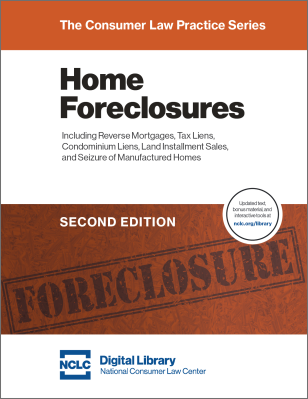
The Tyler and Pung rulings help provide some monetary relief for those who lost their home to a tax taking, but provide little benefit in preventing a tax foreclosure. Resources to avoid loss of a home for unpaid property taxes are found in NCLC’s Housing Practice Suite. Some of these resources are free to the public, some are free to the consumer law community—legal services, NACA, and recent attendees of NCLC conferences. Other resources require a subscription to NCLC’s just-released 2026 revised edition of Home Foreclosures.
NCLC’s Housing Practice Suite also links to resources on “tangled titles” primarily where homes are passed on from generation to generation without a will or without the filing of a probate. Other resources linked at the Housing Practice Suite relate to zombie second mortgages, rights of homeowners after natural disasters, mortgage servicing pleadings, and home equity “investment” loans.

Related Publications
Free First Chapters
The first chapter of each consumer law treatise is available for free in NCLC's Digital Library.
Click any NCLC title below to start reading now:
Debtor Rights
Fair Debt Collection
Consumer Bankruptcy Law and Practice
Student Loan Law
Repossessions
Access to Utility Service
Mortgages & Foreclosures
Mortgage Lending
Mortgage Servicing and Loan Modifications
Home Foreclosures
Deception & Warranties
Unfair and Deceptive Acts and Practices
Federal Deception Law
Automobile Fraud
Consumer Warranty Law
Credit & Banking
Fair Credit Reporting
Truth in Lending
Consumer Credit Regulation
Credit Discrimination
Consumer Banking and Payments Law
Consumer Litigation
Collection Actions
Consumer Class Actions
Consumer Arbitration Agreements