
This article explains:
- NCLC’s new feature allowing you to annotate and highlight your NCLC online treatises
- Other new features for NCLC’s online treatises
- 7 tips to optimize your use of the NCLC Digital Library
- A February webinar on using the online features
- Highlight or annotate key passages or case citations, then return to them instantly in court or conferences by clicking on the appropriate entry from the list at “My Annotations/Highlighting” or from “Notes.”
- Make notes on how treatise passages can later be used in your briefs or other documents.
- Highlight case citations to later read the full text of the decision, or annotate the case citation to remind you of the issue you will look for in reading the case.
- Highlight the key statements in a subsection so you can quickly skim that subsection in the future.
- Red flags in front of chapters in the table of contents indicate a significant law change within the last six months. Click on that chapter and the red flag identifies the subsection with the change. Navigate to that subsection, click “Highlight Updates” at the top of the page, and text changes since the print edition will be shaded.
- Blue flags in front of chapters in the table of contents indicate a very recent update to a subsection, typically within the last six weeks. Click on that chapter and the blue flag identifies the subsection with the recent update. Click “Highlight Updates” to see changes.
- Go to “News & Upcoming Events” on the bottom right of the home page (after logging in) to see a list of all chapters updated for each month—or just go to www.nclc.org/updates.
- PDF files found within the text now have large preview images with captions to show you in advance without opening it what the PDF file contains.
- When searching, use the “Sort by” dropdown at the top of the results page to sort the results by relevance or by section number within each treatise.
- To show more results on a screen, use the “results per page” dropdown at the top of the page to select 25, 50 or 100 results.
- Fewer clicks are now required when you navigate the table of contents. Clicking on a first level section heading opens all second, third and fourth level headings under that first level. If you want to see less on the screen, just close unwanted second level heads.
- Click on a footnote reference in text and a “lightbox” appears displaying the footnote. Click anywhere outside the box to return to the text. If instead you scroll to footnotes at the bottom of the page, return to the corresponding footnote reference in the text by clicking on the footnote number.
We welcome links to this page. For non-commercial purposes, you also have permission to reproduce this page digitally or in print without changes by adding the following language "Reprinted with permission from National Consumer Law Center, www.nclc.org/library."
Free First Chapters
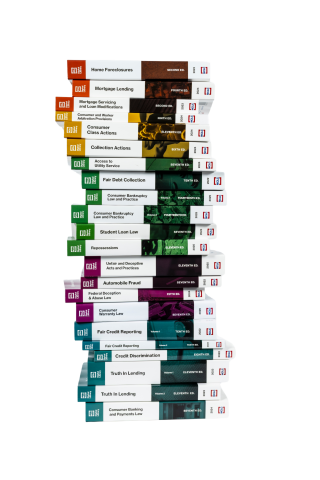
The first chapter of each consumer law treatise is available for free in NCLC's Digital Library.
Click any NCLC title below to start reading now:
Debtor Rights
Fair Debt Collection
Consumer Bankruptcy Law and Practice
Student Loan Law
Repossessions
Access to Utility Service
Mortgages & Foreclosures
Mortgage Lending
Mortgage Servicing and Loan Modifications
Home Foreclosures
Deception & Warranties
Unfair and Deceptive Acts and Practices
Federal Deception Law
Automobile Fraud
Consumer Warranty Law
Credit & Banking
Fair Credit Reporting
Truth in Lending
Consumer Credit Regulation
Credit Discrimination
Consumer Banking and Payments Law
Consumer Litigation
Collection Actions
Consumer Class Actions
Consumer Arbitration Agreements