
This article explains changes to the Bankruptcy Code effective November 10, 2026, concerning eligibility to file a chapter 13 bankruptcy, and changes effective December 1, 2026, to Bankruptcy Rules and miscellaneous fees. The chapter 13 eligibility changes affect those with large debts, such as personal injury judgments or significant student loans owed by both spouses.
The bankruptcy rules changes restore sanctions for credit card issuer abuse in filing proofs of claims. They also extend the time for filing certification of completion of a financial management course, a prerequisite for receiving a bankruptcy discharge, thus helping debtors who completed the course but failed to file the certification. The new rules also offer greater flexibility in allowing for remote testimony in contested bankruptcy matters. The fee change increases some of the bankruptcy miscellaneous fees for inflation.
Chapter 13 Eligibility Debt Limits Increased
Effective November 10, 2026, the Bankruptcy Threshold Adjustment Act, increases debt limits for eligibility to file cases under chapter 13 and subchapter V (small business reorganizations), amending Code sections 109(e) and 1182(1). Pub. L. No. 119-142 (2026).
Under the adjusted amounts, a debtor (or a married couple) with less than $2,750,000 in liquidated, noncontingent debts on the petition date may file a chapter 13 case, and a small-business debtor with less than $7,500,000 in liquidated, noncontingent debts may file a subchapter V case under chapter 11. These new debt limits will be adjusted for inflation every three years under 11 U.S.C. § 104, starting on April 1, 2028. The statutory change ensures that very few consumer debtors will be denied eligibility for chapter 13 based on the new debt limits.
The most significant innovation is that the amendment eliminates the distinction between secured and unsecured debt under the prior law, which prevented a debtor with more than $526,700 of non-contingent, liquidated, unsecured debts or more than $1,580,125 of non-contingent, liquidated, secured debts from filing a chapter 13 case.
Although most consumer debtors were not affected by the prior debt limits, some debtors with large personal injury judgments against them or significant student loan debt did have problems under the separate tests or were compelled to file individual cases rather than filing a joint petition to avoid having their combined debts counted in a joint case. Other debtors were forced to incur litigation costs over whether a particular debt was secured or unsecured (the unsecured threshold being so much lower), such as a debt based on a deficiency judgment after a foreclosure, or when a secured claim will be bifurcated or a judicial lien will be avoided under the debtor’s chapter 13 plan. See NCLC’s Consumer Bankruptcy Law and Practice § 12.2.3.1.
Sanctions Restored for Creditor Abuse of Credit Card Disclosure Requirements
In response to a comment from NCLC, the Bankruptcy Rules Committee restored a sanction for creditor abuse that had been inadvertently lost by the 2024 restyling of the rule. Before the rule was restyled, former Rule 3001(c)(2)(D) authorized a bankruptcy court to impose sanctions on a creditor who fails to comply with the requirements for filing a proof of claim on a credit card debt or other open-end consumer credit agreement.
The open-end rule requires the proof of claim to be accompanied by a statement of:
- The name of the entity from whom the creditor purchased the account;
- The name of the entity to whom the debt was owed at the time of an account holder’s last transaction on the account;
- The date of an account holder’s last transaction;
- The date of the last payment on the account; and
- The date on which the account was charged to profit and loss.
In addition, if requested by the debtor or other party in interest, the credit card holder must provide the writing(s) on which the claim is based within thirty days. See NCLC’s Consumer Bankruptcy Law and Practice §§ 14.4.4.5, 16.5.5.2.
The 2024 restyling redesignated several subsections in Rule 3001(c), leaving the sanction provision applicable only to the general requirements for proofs of claim and not to the specific requirements listed above for open-end consumer credit agreements. While the restyling was intended to be only stylistic, this resulted in an inadvertent substantive change to the rule.
To fix the problem, a technical amendment was made, effective December 1, 2026, that moves the sanction provision and redesignates it as Rule 3001(c)(4). The sanction now applies to the failure to provide “any information required by (c),” which is consistent with the rule before it was restyled.
The amendment clarifies that if a creditor fails to comply, the court may preclude the creditor from offering any evidence in any contested matter or adversary proceeding in the case based on information that should have been disclosed, or award other appropriate relief, including an award of reasonable attorney fees and other expenses to the debtor, caused by the creditor’s failure to comply. See NCLC’s Consumer Bankruptcy Law and Practice § 11.6.2.8.2.8.
Deadline Eliminated to File Certification of Completion of Financial Management Course
To receive a discharge in a chapter 7 or chapter 13 case, the debtor must submit proof of completion of a postpetition financial management course. See NCLC’s Consumer Bankruptcy Law and Practice § 8.3.3. This requirement is implemented by Rule 1007(b)(7), which initially required the debtor to sign and file an Official Form that certified course completion.
Because some debtors’ cases were closed without a discharge if they failed to file the form, even though they completed the course, the Rules Committee adopted a series of rule amendments to simplify the process and reduce the number of cases closed without a discharge:
- In 2010, Rule 5009 was amended to require the court clerk to provide a notice to debtors that their case may be closed without a discharge due to failure to timely file the form certification.
- In 2013, Rule 1007(b)(7) was amended so that a debtor would need to file the form certification only if the course provider had not notified the court of the course completion.
- In 2024, Rule 1007(b)(7) was amended again to no longer require debtors to file a certification to prove that they completed the course, and Official Form was abrogated. Instead, a certificate of completion issued by the course provider must be filed if the course provider does not submit it directly to the court.
Rule 1007(c)(4) until now required the certificate to be filed within 60 days after the first date set for the meeting of creditors in a chapter 7 case, and no later than the date the last payment is made under the plan or the date a motion for a discharge is filed in a chapter 13 case. Effective December 1, the deadlines in Rule 1007(c)(4) for filing the certificate have been eliminated. References to the deadlines were also deleted from Rule 9006, which deals with extending deadlines.
While Rule 1007 no longer imposes a deadline, the certificate still must be filed before the court determines whether a discharge shall enter. If it is not filed before that time, Rule 4004(c)(1)(H) and (c)(4) provide that the court may close the case without granting the debtor a discharge. The debtor may later seek to reopen the case to file the certificate and obtain a discharge, though the current policy of the Judicial Conference is to charge a new filing fee when a case is reopened for this purpose.
Rule 5009 has also been amended to require the court clerk to send two reminder notices of the course certificate filing requirement, rather than just one notice. Rule 5009(b)(2) provides that if the certificate is not filed within 45 days after the petition is filed, the first notice to the debtor must be sent by the clerk stating that the case can be closed without a discharge if the certificate is not filed.
Rule 5009(b)(3)(A) states that in a chapter 7 case, if the certificate is not filed within 90 days after the petition is filed, the second notice must be sent by the clerk stating that the case can be closed without a discharge if the certificate is not filed within 30 days after the notice’s date. In a chapter 13 case, if the certificate has not been filed when the trustee files a final report and account, Rule 5009(b)(3)(B) requires the clerk to send the debtor a notice stating the case can be closed without a discharge if the certificate is not filed within 60 days after the notice’s date.
In short, while these changes provide more notice and flexibility regarding the obligation to file the certificate of course completion, attorneys should continue to work with course providers and clients to ensure the certificate is filed in time for a discharge to be entered.
Bankruptcy Courts Given Greater Flexibility to Permit Remote Testimony in Contested Matters
The bankruptcy rules were amended, effective December 1, to give bankruptcy courts more flexibility to permit remote testimony in contested matters. Contested matters are generally resolved more efficiently and expeditiously than adversary proceedings. See NCLC’s Consumer Bankruptcy Law and Practice § 14.2.4.1. This change was accomplished through the following amendments:
- Rule 9017 is amended to eliminate the general applicability to all bankruptcy cases of Fed. R. Civ. P. 43 (Taking Testimony), which generally governs how testimony is presented in federal civil cases. Testimony in contested bankruptcy matters is governed by Rule 9014(d).
- New Bankruptcy Rule 7043 (Taking Testimony) will retain the applicability of Fed. R. Civ. P. 43 to adversary proceedings and therefore will continue to authorize remote witness testimony in adversary proceedings “for good cause in compelling circumstances and with appropriate safeguards.”
- Rule 9014 is amended to allow a court in a contested matter to permit remote witness testimony “for cause and with appropriate safeguards,” thus eliminating the requirement of “compelling circumstances.”
The Advisory Committee Note accompanying the change to Rule 9014 states that: “Although the amendment to Rule 9014(d) removes the ‘compelling circumstances’ requirement in Fed. R. Civ. P. 43(a), the court still must find cause to permit remote testimony and must impose appropriate safeguards.” The Note further states that while “remote testimony in contested matters should not be routine,” and in-person testimony in open court may be “particularly appropriate in disputed contested matters where it is necessary for the court to determine the witness’s credibility,” remote testimony in contested matters “could be useful in consumer cases if the matters are straightforward and witness attendance is cost prohibitive or infeasible due to travel, job, or family obstacles.”
Inflation-Adjusted Increases to Bankruptcy Court Miscellaneous Fees
The Judicial Conference of the United States approved, effective on December 1, 2026, inflation adjustments to certain fees that may be charged in bankruptcy cases pursuant to 28 U.S.C. § 1930. These new fees are listed on the Bankruptcy Court Miscellaneous Fee Schedule.
Of the fees that have been adjusted, the following are the most common in consumer bankruptcy cases:
- For filing amended bankruptcy schedules, the fee has been increased from $34 to $38.
- For filing motions to terminate the automatic stay, to compel abandonment of estate property, to withdraw the reference, to sell estate property free and clear of liens under section 363(f), the fee has been increased from $199 to $221.
- For a motion to redact personal identifying information, the fee has been increased from $28 to $31.
- For reproduction of an audio recording of a court proceeding, the fee has been increased from $34 to $38.
All the fee changes are listed here.

Related Publications

Free First Chapters
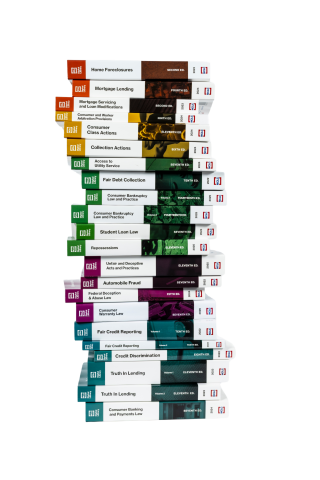
The first chapter of each consumer law treatise is available for free in NCLC's Digital Library.
Click any NCLC title below to start reading now:
Debtor Rights
Fair Debt Collection
Consumer Bankruptcy Law and Practice
Student Loan Law
Repossessions
Access to Utility Service
Mortgages & Foreclosures
Mortgage Lending
Mortgage Servicing and Loan Modifications
Home Foreclosures
Deception & Warranties
Unfair and Deceptive Acts and Practices
Federal Deception Law
Automobile Fraud
Consumer Warranty Law
Credit & Banking
Fair Credit Reporting
Truth in Lending
Consumer Credit Regulation
Credit Discrimination
Consumer Banking and Payments Law
Consumer Litigation
Collection Actions
Consumer Class Actions
Consumer Arbitration Agreements