
(Article updated: Jan. 21, 2026)
This article examines the most significant 2025 Fair Debt Collection Practices Act (FDCPA) developments, including summaries of all reported FDCPA circuit court of appeals decisions, a discussion of withdrawn guidance at the CFPB, and the just-released Eleventh Edition of NCLC’s Fair Debt Collection treatise.
2025 Reported Circuit Court of Appeals FDCPA Decisions
Article III Standing
Milam v. Selene Fin., L.P., ___ F.4th ___, 2025 WL 3705698 (7th Cir. 2025). Consumer alleged that the mortgage servicer violated the FDCPA when it falsely threatened acceleration and foreclosure if she did not cure her default within 35 days, prompting her to pay by the deadline. The Seventh Circuit held that the consumer alleged a concrete injury sufficient to establish Article III standing because she did not avoid additional interest, she had to borrow funds to pay for health insurance, and she incurred overdraft fees to pay for food, and utilities due to paying by the stated deadline.
Denmon v. Kansas Counselors, Inc., 149 F.4th 1010 (8th Cir. 2025). Consumer alleged a violation of § 1692c(c) when she received a collection letter verifying the debt after sending a fax to the collector stating “I dispute this debt. Please do not contact me about this debt.” The majority held that the consumer lacked standing because the verification letter was required by the Fair Credit Reporting Act in response to the consumer’s dispute, was not an intrusion upon seclusion, and did not establish concrete injury. The dissent found that the harm of receiving an unwanted letter was intrusive, that the consumer had met her burden of pleading a harm similar in kind to one recognized at common law, and that the degree of harm was not relevant.
Six v. IQ Data Int'l, Inc., 129 F.4th 630 (9th Cir. 2025), petition for cert. denied, 24-1326 (U.S. Oct. 6, 2025). Consumer alleged that the collector sent him a verification letter after he notified them that he was represented by an attorney and thus violated § 1692c(a)(2). Reversing the lower court, the Ninth Circuit held that the consumer did have standing because the consumer’s receipt of a debt collection letter after notifying the collector of legal representation “is the type of infringement on privacy interests that Congress contemplated when it enacted the FDCPA” and the “harm caused by unwanted communications bears a close relationship to intrusion upon seclusion.” The court also held that the kind of harm was analogous to the tort of intrusion upon seclusion even though the consumer only received one letter, declining to adopt the Seventh Circuit’s position in Pucillo v. National Credit Systems, Inc., 66 F.4th 634 (7th Cir. 2023), which held that receipt of two letters by the consumer was “too far afield” from intrusion upon seclusion to establish concrete injury.
Thomas v. LVNV Funding, L.L.C., 132 F.4th 992 (7th Cir. 2025). Consumer alleged that the debt collector violated § 1692e(8) by waiting 29 days after the receipt of her dispute letter to report the account as disputed. A jury awarded the consumer $250 in statutory damages. On appeal, the Seventh Circuit held that the consumer did not have standing to sue because she did not produce any admissible evidence of injury due to the delay in reporting the account as disputed.
Wood v. Security Credit Servs., L.L.C., 126 F.4th 1303 (7th Cir. 2025). Consumer alleged that the debt buyer violated § 1692e(8) by reporting an account on his credit report without noting that it was disputed. The Seventh Circuit held that the consumer had established standing on summary judgment because “the record shows that a debt marked as disputed negatively impacts a credit score less than a debt that is not marked as disputed.” The consumer did not have to establish the merits of the dispute to show standing.
Pay-to-Pay/Convenience Fees
Glover v. Ocwen Loan Servicing, L.L.C., 127 F.4th 1278 (11th Cir. 2025). Consumers alleged that the collector violated § 1692f(1) when it charged fees for making expedited mortgage payments by phone. The Eleventh Circuit held that the collector violated § 1692f(1) because the collector was a debt collector collecting a debt, the convenience fees qualified as “any amount,” and the amount of the fee was not authorized by the mortgage or permitted by relevant state law.
Failing to Report Disputed Debt as Disputed
Wood v. Security Credit Servs., L.L.C., 126 F.4th 1303 (7th Cir. 2025). Consumer alleged that the debt buyer violated § 1692e(8) by reporting an account on his credit report without noting that it was disputed. The Seventh Circuit held that the "know or should know" standard of § 1692e(8) is a negligence standard that “holds debt collectors to a duty of reasonable care not to report false information” and that the consumer must prove by a preponderance of the evidence that the collector knew or should have known that the debt was disputed.
The Seventh Circuit reversed summary judgment for the debt buyer that claimed that it shared the creditor’s understanding that the consumer’s silence after the creditor verified the debt to mean that he no longer disputed it. The court held that the debt buyer’s “understanding of what makes an account ‘disputed’” was itself a disputed issue of material fact and remanded the case for the determination of whether the debt buyer should have known that the debt was disputed. If the debt buyer should have known that the debt was disputed, then this was a mistake of law, not a “clerical or factual mistake,” that would preclude a bona fide error defense.
Cease Communication
Denmon v. Kansas Counselors, Inc., 149 F.4th 1010 (8th Cir. 2025). Consumer alleged a violation of § 1692c(c) when she received a collection letter verifying the debt after sending a fax to the collector stating “I dispute this debt. Please do not contact me about this debt.” The Eighth Circuit held that due to a fax raising a dispute in addition to the cease communication request it conflicted with the debt collector’s obligation to respond to the dispute under Fair Credit Reporting Act and thus was not a valid basis for a § 1692c(c) claim.
Collateral Estoppel
Delgado v. Midland Credit Mgmt., Inc., 131 F.4th 896 (8th Cir. 2025). The consumer sued the debt buyer for violating FDCPA §§ 1692e and 1692f by trying to collect a debt without owning it. The Eighth Circuit ruled that the claims were collaterally estopped by a default judgment entered in a Minnesota state court collection lawsuit. Under Minnesota law, the debt buyer was required to provide evidence of chain of assignment in order to obtain a default judgment. The court held that the default judgment qualified as a final judgment on the merits because the court had to evaluate the evidence establishing chain of assignment and this was a merits determination.
Collection After Bankruptcy
Koontz v. SN Servicing Corp., 133 F.4th 320 (4th Cir. 2025). The consumer received two letters from the servicer after discharging the personal obligation secured by the mortgaged property in a chapter 7 bankruptcy. The Fourth Circuit held that the definition of “consumer” was satisfied under § 1692a(3) because the in rem obligation on real property was sufficient to satisfy the “obligated or allegedly obligated to pay any debt” portion of the definition. The Fourth Circuit also held that the letters were efforts to collect a debt because they involved possible foreclosure. The consumer stated a claim under § 1692f(1) by alleging late fees that violated the contract and § 1692f by alleging that the servicer refused to accept certain payments. The court dismissed the consumer’s § 1692e claim for failure to identify which state was false, deceptive, or misleading.
Reduction of Attorney Fees
Woodward v. Credit Service Int’l Corp.,132 F.4th 1047 (8th Cir. 2025). Consumer attorney appealed a district court order awarding reduced attorney fees after settling an FDCPA claim. The Eighth Circuit affirmed the district court’s determination that $350 was a reasonable hourly rate (reduced from the requested $450 per hour) and 34.5 hours (reduced from 72.4 hours requested) was the reasonable number of hours expended.
Rule 11 Sanctions
Sofaly v. Portfolio Recovery Assoc., L.L.C., 155 F.4th 289 (3d Cir. 2025). A law firm wrote dispute letters on behalf of consumers. The lawyers at this firm intentionally included extraneous information and wrote the letters by hand to make it more likely that the debt collector would overlook the dispute and allow the law firm to sue for a § 1692e(8) violation if the debt was not reported as disputed to the credit bureaus. The Eleventh Circuit affirmed the district court’s finding that the attorneys and their firm violated Rule 11 “by submitting complaints based on misrepresentations and half-truths to harass [the collector], increase its litigation costs, and gin up attorneys' fees.” The court also affirmed the award of fees and costs to the collector’s counsel because the consumer attorneys had acted in bad faith and committed fraud on the court.
Withdrawn CFPB Guidance Concerning Debt Collection
On May 12, 2025, the CFPB withdrew 67 of its guidance documents. See 90 Fed. Reg. 20,084 (May 12, 2025).
Among the guidance documents withdrawn were three FDCPA advisory opinions:
- Debt Collection Practices (Regulation F); Deceptive and Unfair Collection of Medical Debt, 89 Fed. Reg. 80,715 (Oct. 4, 2024).
- Fair Debt Collection Practices Act (Regulation F); Time-Barred Debt, 88 Fed. Reg. 26,475 (May 1, 2023).
- Debt Collection Practices (Regulation F); Pay-to-Pay Fees, 87 Fed. Reg. 39,733 (July 5, 2022).
Other withdrawn FDCPA and debt collection guidance documents were:
- Bulletin 2023-01: Unfair Billing and Collection Practices After Bankruptcy Discharges Certain Student Loan Debts, 88 Fed. Reg. 17,366 (Mar. 23, 2023).
- Consumer Financial Protection Circular 2022-05: Debt Collection and Consumer Reporting Practices Involving Invalid Nursing Home Debts, 87 Fed. Reg. 57,375 (Sept. 20, 2022).
- Bulletin 2022-01: Medical Debt Collection and Consumer Reporting Requirements in Connection with the No Surprises Act, 87 Fed. Reg. 3025 (Jan. 20, 2022).
- Bulletin 2015-07 re: In-Person Collection of Consumer Debt (Dec. 16, 2015).
- Bulletin 2013-07 re: Prohibition of Unfair, Deceptive, or Abusive Acts or Practices in the Collection of Consumer Debts (July 10, 2013).
The CFPB characterized the mass withdrawal of guidance documents as a stay of their use in CFPB enforcement while the CFPB evaluated each guidance document to see if it should be retained. The mass withdrawal does not constitute the CFPB’s rejection of the content of any of the specific withdrawn documents.
Although they should not be cited as a representation of the current CFPB’s interpretation, courts may still find the reasoning used in withdrawn guidance documents persuasive. Most importantly, the withdrawn guidance documents did not alter the FDCPA or Regulation F. For more information, see NCLC's Continued Vitality of 67 Withdrawn CFPB Guidance Documents.
New 11th Edition of Fair Debt Collection
The digital edition of the new revision of NCLC’s Fair Debt Collection (11th ed. 2026) has just been published, and the print edition will be available later in January and sent at no charge to print subscribers. Fair Debt Collection is the definitive FDCPA treatise, relied on for over 40 years and cited by the U.S. Supreme Court.
The treatise provides all the tools a practitioner needs to successfully bring an FDCPA lawsuit. Featured is an entire chapter about constitutional standing in federal courts for FDCPA claims, detailed analysis of all Regulation F requirements, and sample pleadings and discovery. The treatise also comprehensively covers other sources of debt collection law—state debt collection statutes, common law torts, UDAP, and various federal statutes relevant to debt collection litigation. For more information on subscription options, visit our bookstore.

Related Publications

Free First Chapters
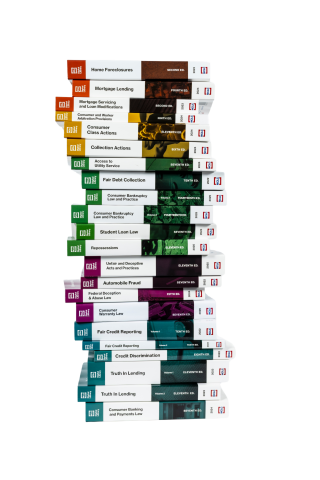
The first chapter of each consumer law treatise is available for free in NCLC's Digital Library.
Click any NCLC title below to start reading now:
Debtor Rights
Fair Debt Collection
Consumer Bankruptcy Law and Practice
Student Loan Law
Repossessions
Access to Utility Service
Mortgages & Foreclosures
Mortgage Lending
Mortgage Servicing and Loan Modifications
Home Foreclosures
Deception & Warranties
Unfair and Deceptive Acts and Practices
Federal Deception Law
Automobile Fraud
Consumer Warranty Law
Credit & Banking
Fair Credit Reporting
Truth in Lending
Consumer Credit Regulation
Credit Discrimination
Consumer Banking and Payments Law
Consumer Litigation
Collection Actions
Consumer Class Actions
Consumer Arbitration Agreements